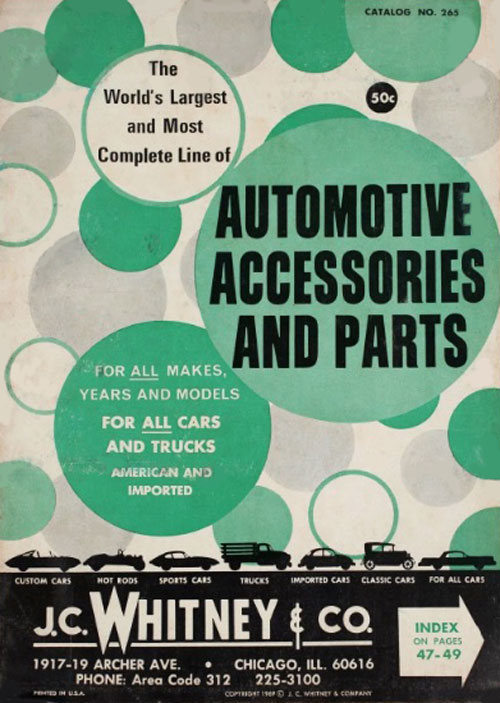
When I was thirteen years old, I discovered two magazines. The first was one my friend Billy and I found under my father’s bed, the name of which goes without saying. The second was the JC Whitney Catalog.
Thirteen was the age I became enamored with Volkswagens. My father bought a dark green ’56 and that was the beginning of a lifelong love affair with The People’s Car. Not long afterwards he drove up to the drugstore in Gresham Park for a pack of Lucky Strikes and brought home a Whitney Catalog. JC Whitney was a mail order house in Chicago that specialized in automotive parts and accessories. All of the parts were aftermarket, but it didn’t matter. They fit, they worked and they cost about half of what original equipment parts cost.
For a thirteen-year-old boy chomping at the bit to learn to drive and infatuated with all things automotive, the JC Whitney catalog was like the Sears Christmas Wish Book, only better. A new catalog was published every quarter. The Wish Book only came out once a year. Although I, like every other kid on the block, had eagerly awaited the Wish Book’s arrival in the mail every September, I was now a maturing young man of thirteen. I was more interested in girls, sports, cars, clothes and cologne, pretty much in that order. I had outgrown most of the juvenile merchandise available through the Sears Christmas catalog. The JC Whitney Catalog had become my new Wish Book.
And what a Wish Book it was! Virtually every part for every car built in the United States was available through Whitney, even complete engines. Aside from the usual array of tires, batteries and mufflers, the JC Whitney catalog offered a plethora of hood scoops, wheel covers, spoilers, fender flares, seat covers and just about every body part for a vintage Jeep or Volkswagen Beetle that was merely a phone call or mail-order form away.
Along with the legitimate parts, the catalog also contained a wide array of some of the most wonderfully wacky and tacky add-on gadgets you could imagine that could turn any ordinary car into a custom cruiser. First, there were the horns. Crazy horns that made all kinds of sounds, such as ship horns, ooga horns, animal sound horns, wolf whistle horns and musical horns that could be set up to play anything from La Cucaracha to Dixie. The animal sound horns included one that “whinnied like a real Mustang” and a donkey horn that would “Hee-Haw” to get attention. Here are a few of the other non-factory installed conveniences and luxuries that were available:
Automotive Radio Phone: This device predated the cell phone by at least two decades. Likely sold to make even factory workers feel like overpaid executives behind the wheel, it essentially turned a car, truck or boat into a low-power radio station that boasted a range of up to 10 miles.
Dashboard Record Player: I’m not kidding. Before the 8-track tape deck, this was the only option other than the radio. The catalog claimed it “performed smoothly over rough roads, curves and even during fast starts and stops”, although I seriously doubt it.
Deluxe Left Foot Accelerator: Not your standard left foot accelerator, but the deluxe model. I suppose the idea was that a driver’s right foot would get tired over a long trip, so he or she could simply switch over to the left foot. It’s a good thing this feature never became mainstream.
Door-Re-Mi Door Chime: Whenever a car door was opened, an enchanting melody of Do-Re-Mi, Let Me Call You Sweetheart, I Love You Truly or Ave Maria was played loudly. If you were a teenager, you could forget abut sneaking out at night or coming home late undetected with this alert installed.
Fuzzy Car Muffs: A short-lived craze where people dressed up their rides by wrapping fuzzy white fur over rear-view mirrors, steering wheels, dashboards, visors and rear window panels. It made a car look like a rolling den of iniquity.
Steering Wheel Spinner Knob: This gadget allowed one-handed driving, allowing the suave and debonair driver the ability to hold a lit cigarette or drape an arm around a date’s shoulders. The problem was that the knob only clamped onto the steering wheel, so if it came loose it would remain in your hand while the wheel snapped back into whatever position it desired.
Gyroscopic Stabilizers: “Calibrate the gyroscopic stabilizers, Mr. Scott!” This gizmo allegedly increased tire life, automatically balanced wheels, ironed out bumps and improved handling. Yeah, right.
In-Car Coffee Maker Kit: This was an actual factory option for Volkswagen Beetles in 1959. The Whitney version secured to the dashboard and plugged into the cigarette lighter outlet. Unfortunately neither the travel mug nor cup holder had yet been invented, so we can only imagine the pain and danger of suffering a lapful of hot java while operating a moving automobile.
Whitewall Kit: This kit turned your Fisk Retreads into high-end sidewalls. I would hope that not many people expected paint-on whitewalls to look as good or last as long as the real thing, but at least Joe Lunchpail’s Chevy could have whitewall tires just like the Joneses Continental.
Volkswagen Hand Starter: Don’t laugh. I had one and it worked. No jumper cables on board or the starter conked out? No sweat, just wrap the strap around the generator pulley and give it a yank, lawn mower style. Hey, at least it got you home or to the VW garage on the corner.
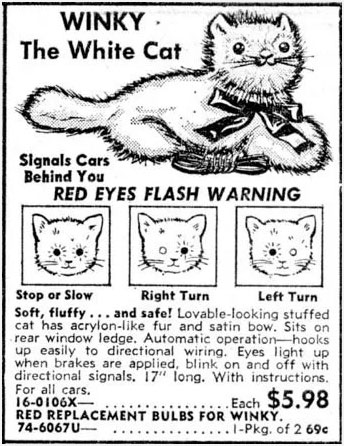 And finally there was Winky The Cat: Winky was a stuffed cat that sat on your car’s rear window deck. He was wired to your lighting system and had eyes that blinked if you were turning left or right. Both eyes came on when you applied the brakes. Tacky as it was, it was actually a precursor to the center high-mounted brake lights now required on all vehicles. Not a cat person? No problem, you could also order Mac The Dog or Duchess The Tiger.
Not all the accessories Whitney carried were tacky, of course. My ’56 VW was outfitted with a very nice walnut shifter knob with a clear acrylic dome over the shift pattern diagram and matching walnut dash knobs. It also had black cutpile floor mats, front and back and black vinyl seat covers, all from the catalog.
The last time I ordered from Whitney was in early 1990. My friend Frank, who owned a body shop, kept my ’69 VW convertible over the winter. He stripped the paint down to the bare metal, fixed a few dings, primed and painted it. He also put new floor pans in, which I had ordered from Whitney and had them shipped to the shop. He told me the pans were likely not going to fit exactly and he would probably have to do some cutting to make them work. A few days after they arrived, Frank called me up. “You’re not going to believe this,” he said. “Those things dropped in perfectly. All I had to do was weld them in.” He sprayed undercoating on the bottom and top of the pans and they have been in the car ever since, without a hint of rust or deterioration.
JC Whitney was acquired in 2010 by CarParts.com. The name does continue as a digital publication at jcwhitney.com, but in name only. The old catalog is just a distant memory, a memory that harkens back to simpler age and time, a time of do-it-yourself auto repair and customizing. A time of a young teenager dreaming of all the cool stuff with which he was going to turn his first car into a cruising vessel. It was all right there in the JC Whitney catalog. And my father didn’t have to keep it hidden under his bed.