Concours to Cruise-Ins | Let The Season Begin

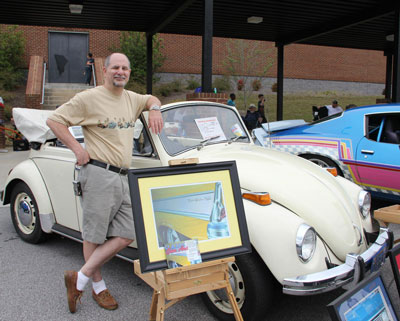
jimmyandthebugSpring is here (well, almost, anyway…), and that means a new season of car shows, club functions, cruise-ins and rod runs.  Just about any vehicle you can imagine, from cars to bikes to trucks, can be found at these gatherings throughout the spring, summer and fall months.  You’ll also meet some pretty wonderful folks who share your love and enthusiasm for whatever particular vehicle revs your RPMs…

There is a function of some type just about every weekend, and you can check the event schedules at websites such as southeastwheelsevents.com and carshowfinder.org.   Churches, civic groups and charities have found car shows to be a great and fun way to involve communities and to raise funds and awareness.

If your tastes run more to the upper echelon of the motoring class, there is the Amelia Island Concours d’ Elegance going on this weekend, March 10-16 at Amelia Island, Florida.  The Highlands Motoring Festival is happening June 9-12 in Highlands, NC, and the first annual Atlanta Concours d’ Elegance, benefiting St. Judes Children’s Hospital, takes place May 14 in Alpharetta, Ga.  These shows feature some of the finest and most elegant antique automobiles in the world.

The Southland Jubilee,  in Greensboro, Ga. will be Saturday, April 16th.  This event is sponsored by Georgia Classic Cruisers.  Make plans to come out to beautiful East Georgia and spend a beautiful spring day enjoying the company of some great folks and more than 150 classic cars!  I’ll see you there, but in the meantime… Keep Cruisin’!  –J.  
Chevrolet Corvair | Unsafe At Any Speed?

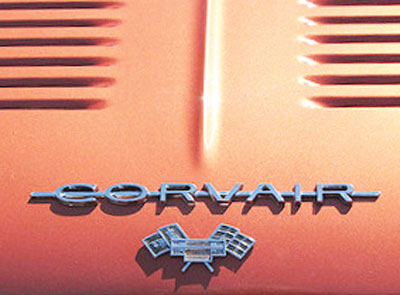
corvairlogoA friend asked me recently if I had ever considered painting a Chevy Corvair.  Ah, the Chevy Corvair, introduced in 1960 to compete in the growing compact market.  Corvair’s flat horizontally opposed rear mounted 6 cylinder engine opened up room for a variety of packages which made the car widely popular. As a kid, my dream car was a candy-apple red Corvair Monza with a black interior.  I wound up with a green ’56 VW…

The Corvairs were a blast to drive.  A friend had a maroon ’69 Monza Spyder that was an absolute beast. With a 150 hp turbocharged engine, this little monster would eat up the roadway like spaghetti. The Corvair also looked cool too, sporting lithe and sleek lines with which the Ford Falcon, Dodge Dart and of course, the VW, simply could not compare.

Then along came Nader.  Chevy execs knew the Corvair was a handful, but refused to spend the few dollars per car to make the swing-axle suspension more manageable.  It was a decision they would come to regret… 

Ralph Nader, a consumer activist who probably drove a Nash Rambler and got beat up a lot as a kid, published a book called “Unsafe at Any Speed” in 1965.  The book outlined safety issues with a number of American cars, and called the Corvair a “one-car accident”.  Citing the car’s propensities for spins and rollovers, it was the death knell for the Corvair, which ceased production in 1969.

Which brings me to my point… isn’t any car unsafe at any speed at any point in time?  Depending on how we are driving at a certain point, isn’t any vehicle a rolling death trap?  If we are flying down the road well over the speed limit and go into a curve way too fast, isn’t that vehicle going to have a propensity to spin or roll?  Unsafe at any speed?  Try driving a ’69 VW 70 mph on an expressway.  Talk about unsafe… you’ll get run over.

So, yes, I will paint a Corvair portrait.  A nod to a great little American car that was ahead of its time and wound up getting the shaft.  Gee thanks, Ralph.  Oh, and Ralph, I see Corvairs at car shows quite often.  They’re Still Cruisin’!  – J. 

Days of Thunder | Dirt Trackin’ Go-Carts

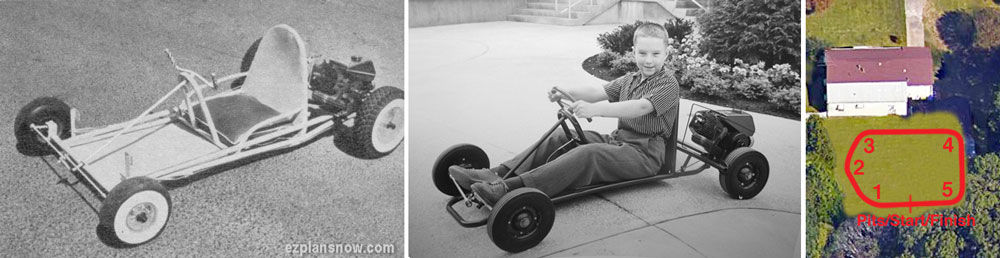
forest-park-speedwayContinuing in the racing vein, since today is the Atlanta 500 at AMS, allow me to wax nostalgic.  I grew up racing go-carts against my cousin Herb, in his back yard in Forest Park, Ga.  The sleek machines above resemble ours, his on the left, mine on the right.  Only Herb’s didn’t sport whitewalls, and that’s definitely not me in the one on the right.

Every Sunday we would load up my go-cart in my father’s 1960 Chevrolet Apache pickup and head to Forest Park.  The little house on Alice Street where my aunt and uncle raised five wonderful kids had a huge back yard.  That became our dirt track.  

As pictured above, it was in effect a tri-oval.  The pits and start/finish line were at the top of the yard.  Our fathers were our pit crews, and we actually raced.  They would count a pre-determined amount of laps each heat.  We raced backward, left to right. Out of the pits there was turn one, the straightaway, a slight turn two, the straight into turn three. the back straight, a tight, tight turn four, the straightway along the fence which miraculously, to my recollection, neither one of us ever got into.  Lastly was turn five to the start/finish line.

We would race all afternoon and my thanks go out to the neighbors because to my knowledge, they never complained.  In the summer the pit crews would water down the track while we were running.  If my car happened to sling the chain on the backstretch, as it was wont to do, I would jump out, roll it back on, jump back in, buckle up, adjust my goggles and take off, hell bent on catching and passing my cousin.  Yes, we had lap belts and goggles.  No helmets.  I wanted one, but they cost too much.  Somehow, no one ever got hurt.

One of my cousins got on the mini-bike and went around and around the track until she ran out of gas because she couldn’t figure out how to stop.  The track wasn’t big enough for another cousin, Sheryl, who inherited the go-cart after Herb and would take it to the streets, only to be chased home by the Forest Park Police.

These are some of the fondest memories of my childhood.  And today, anytime I climb into one of the fancy five dollar a lap racing karts, I am taken back to the old dirt oval at 761 Alice Street.  In my mind, no track anywhere, from Daytona to Dixie, could ever compare.  Keep cruisin’! –J.   


The Urge To Race Is Inside Us All

the-kingToday is the 3rd Sunday in February.  The culmination of Speed Week.  The beginning of the racing season.  Today is the day of The Great American Race, the 58th Daytona 500.

And yes, the Urge to Race is inside us all.  Not to just be there watching, but to actually be driving a race car.  Why else would we plop down upwards of $500 for 8 minutes of driving a real race car on a real track?  Whether it be oval or road course, the Urge to Race is inside us all.

However, many of us cannot afford the luxury of a Race Experience, so we take matters into our own hands.  How many times have we accelerated up to a curve, backed off going in, and gave it the juice halfway through?  How many times have we been on the open road, seen the familiar S with an arrow road sign, felt that familiar feeling inside, and punched it through the turns?

While I certainly am not promoting street racing, I am simply saying that whenever possible, we practice the art of going fast without going fast.  Incidentally, if you are driving a Ford F-150 70 mph inches off the rear bumper of a Toyota Corolla, you are not drafting. You’re just being a jerk.

We will pay $35 for 10 minutes on a go-kart track, complete with a helmet and fire suit.  If we outrun our buddies, we leave exhilerated, convinced that we just won at Road Atlanta, Sebring or LeMans.  Yes,  the Urge to Race is inside us all.  

So today, we will watch the Great American Race, cheer for our favorite driver, and remain convinced that we could be right there in traffic with ’em, rubbin’ paint.  Yeah, right…  Ladies and Gentlemen, Start Your Engines.  Let the Season begin… –J.


Riding In Cars With Dogs

maggiedriving3
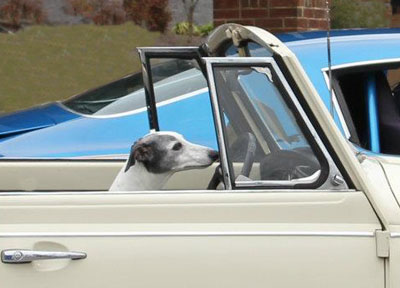
If there’s one thing most of us love more than riding in our car, it’s riding in our car with our dog.  Dogs and cars share a unique bond. When you open the door, whether they knock you over to get to their favorite window or hop quietly onto the back seat, dogs love riding in cars.

Why?  Why do dogs ride with their head up and in the wind, a look of pure happiness on their face?  My first thought is that it’s the same reason we humans love riding motorcycles.  But there are some other reasons given by folks who are a lot smarter than me as to why Fido loves Goin’ Mobile. 

Kevin Behan of Natural Dog Training believes that dogs love car rides because they produce some of the same euphoric sensations as hunting.  Dogs are pack animals and the motion stimulates a sensation similar to moving with the pack.

It’s no secret dogs smell better than us.  I mean with their noses… trust me, I once owned a beagle. When riding with the windows down, there is no doubt a smorgasbord of olfactory sensations that would be overpowering to us and sheer heaven to a dog.  If he’s happy sniffing out the mundane and familiar scents in the backyard, imagine how thrilling it is to experience thousands of new scents every minute!

So, why do we love riding in our car with our dog?  That’s easy for any one of us who love both.  The joy and happiness of the open road with our best friend is a feeling unlike any other.  A pooch riding shotgun can even make being stuck in traffic more bearable.  And if they need to make a pit stop, all that’s needed is a strip of grass.  Just make sure you’ve got your scooper and plastic baggie… and Keep Cruisin’!  –J.

Point A to Point B | The Open Road

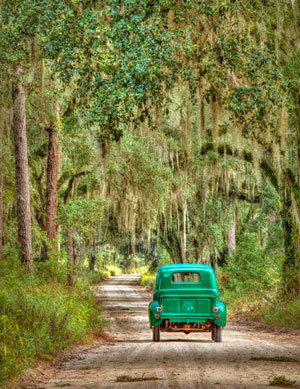
gabackroadWhy do we love to drive so much?  Pared down to the very basics, an automobile is a machine designed for transportation.  Point A to Point B, if you will.  But, we all know driving is so much more than that.  Whether blasting a powerful automobile through curves and over hills, or puttering down a dirt road in an old pickup, driving gives us thrills and feelings unlike any other.

The vehicle we choose for everyday use speaks volumes about us.  Whether functional for work, for sport or for family, our cars become part of us.  We name them.  We pamper them.  In many ways, we treat them better than we treat ourselves.  We may even become angry at them, but we always forgive them.  We keep them, sometimes much longer than we should, because we are unable to let go. 

Without a doubt, the automobile is one of the greatest inventions of the 20th century.  Just as the personal computer and internet would do some 80-90 years later, the Model T suddenly made the world a lot smaller.  Henry Ford’s vision was to “build a car for the great multitude. It will be large enough for the family, but small enough for the individual to run and care for. It will be constructed of the best materials, by the best men to be hired, after the simplest designs that modern engineering can devise. But it will be so low in price that no man making a good salary will be unable to own one – and enjoy with his family the blessing of hours of pleasure in God’s great open spaces.”   

Thank you, Mr. Ford.  You clearly had much more in mind that getting from Point A to Point B.  Keep Cruisin’!  –J.

The Rainbow Bridge | Why We Love Our Cars

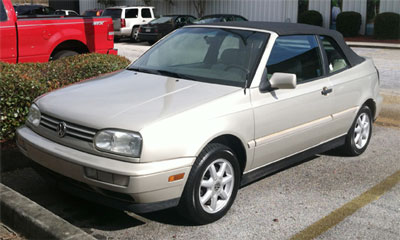
Cabrio400I sold my 1999 VW Cabrio last week.  I know that most of you do not understand the gravity of that statement.  It is a sentence I thought I would never write.

I bought the Cabrio new in 1999. It was the best car I have ever owned, and over the years he became an old and dear friend. Together we made numerous trips to Florida and countless trips to the golf course. We participated in a bike ride for charity.  We took many trips to the mountains and rides through the beauty of the East Georgia farmland.

Tuesday, January 28, 2014 was our greatest ride ever, and bonded me to this little car in a way I cannot explain.  This was the day of the infamous 2″ snowstorm which crippled Atlanta.  Say what you will, but I was out there in it and believe me, it was a treacherous nightmare.  I left work in Smyrna at 3 pm.  We fell in behind a tanker on I-285 just below I-20 and followed him closely all the way.  The little Cabrio kept chugging along and never once got stuck.  My greatest fear was that someone sliding and fishtailing would hit us.  The Cabrio had never been wrecked, you see.  The tanker, the Cabrio and I broke free of the mess at I-85 and I-285 by the airport.  We made it home to Conyers at 10 pm.

Why is it so hard to say goodbye to our cars?  The Cabrio was running fine, but he was falling apart.  The electrical system was shot, and kept draining the brand new battery.  The top was leaking, the brakes needed new rotors and pads, the interior a complete makeover.  I refused to give up, and spent way too much money last summer keeping him in the road.  Not a smart decision financially, but we did have one more season in the sun together.

Why do we love our cars so much?  I think it is due to the fact they are an extension of us and our personality.  We depend upon them so much, they often eventually become part of the family.  That is why it becomes so hard to let them go.  So, goodbye, Cabrio, old buddy.  If there’s a Rainbow Bridge for cars, I know you’ll be there waiting for me… Keep Cruisin’!  –J. 


Saturday Morning Mechanic | Do It Yourself

classicRemember the good old days when you could work on your car?  Sadly, those days have passed.  With the advent of technology, computer chips and digital readouts, it is simply not possible for us to do a Saturday morning tune up in our garage.

Don’t get me wrong, technology definitely has its advantages.  Cars are a lot more dependable these days.  They are being engineered and built to go several hundred thousand miles in a life span.  Technicians (no longer mechanics) can plug in to your car’s computer, run diagnostics and determine problems quickly and easily.  All this is great.  But still…

Remember when you or one of your buddies would buy a new car and you all would stand around and marvel at the engine?  Nowadays, open the hood and all that’s visible are shapes and belts.  You can’t even see the engine, let alone work on it.  

Call me nostalgic, but I long for the days when I would watch my father and uncle put a dyno tune on our Fairlane or my grandfather’s ’57 Chevy.  Everything was right there in plain sight.  The spark plugs, distributor, oil filter, carburetor, master cylinder and battery were easily accessible.  You could get what you needed at the local parts store for less than $20 and do a full tune up and oil change in an hour or so.  Nowadays, you can’t even change your own oil.  You may find the drain plug, but you’ll need special tools, a laptop and an engineering degree to find the filter.  An appointment must be made for a tune up, which will cost more than what was my monthly payment on my Mach 1.  

As a result, as fathers and grandfathers, we are denied the joy of bonding with our sons and grandsons, teaching them the workings of the internal combustion engine and how to maintain and care for a fine automobile.  Today, we take them to the 10 minute oil change, sit in the lobby while they play games on their pads and we watch infomercials on the TV.  We can’t even watch Saturday morning cartoons with them anymore.  They took those, too.  Keep Cruisin’… –J.

The Roundabout | A Perfect Circle

roundaboutChristmas and New Years vacation is over, refreshed, ready to get back to work!  In this edition of Car Talk, we’re going to discuss a European form of traffic engineering, the roundabout.  It is being used more and more stateside and the GDOT.  Sometimes incorrectly referred to as a “traffic circle”, the roundabout is incredibly easy and efficient, provided you understand and practice a few simple rules.

1:  USE YOUR TURN SIGNAL!  This is a rule that can be used anywhere, not just roundabouts.  The turn signal is standard equipment on all cars and easy to use, up for a right turn, down for a left turn.  We’ll cover this in more detail in a later edition of Car Talk.  When approching a roundabout, if you are making a right hand turn, TURN ON YOUR RIGHT SIGNAL!  If you are in the roundabout and about to make a right and a car is waiting, TURN ON YOUR RIGHT SIGNAL!  This lets the driver know you are turning and they can proceed on.

2:  YIELD TO THE TRAFFIC IN THE ROUNDABOUT.  When you see a gap in traffic, enter the roundabout. If someone in the roundabout is making a right and properly using their turn signal as outlined above, you may enter.  Approaching a roundabout and no traffic is present, do NOT stop and look both ways!  No traffic is coming, proceed on.  Just remember to slow down when entering, don’t hit the roundabout at full speed.

3:  NEVER, NEVER STOP IN THE ROUNDABOUT!  I have actually seen this happen.  If you are in the roundabout, follow it to your turn, make your turn and proceed on your way.  Vehicles waiting to enter the roundabout are waiting on a gap.  You do NOT need to stop and let someone enter.

Here is a link to the Washington State DOT website covering negotiation of a roundabout, and applies anywhere.  Keep Cruisin’!  –J.

http://www.wsdot.wa.gov/safety/roundabouts/  


Love and Cars | You Never Forget Your First

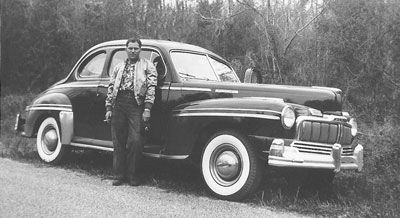
47mercuryTwo things we all remember, no matter what… our first love and our first car.  While my first love shall remain anonymous in this space, my first car was a 1956 Volkswagen Beetle, as mentioned in an earlier post.  

It was dark green and came out of Wolfsburg that way.  It had no gas gauge, but a reserve tank handle under the dash.  If you ran out of gas, you turned the handle and could go another 40 miles or so.  If you ran out of gas after that, you had no one to blame but yourself.  There were semaphore turn signals that actually worked.  If you were making a left turn, you turned a knob and the signal flew up from the left window post.  Same for the right, and I cannot for the life of me remember how they were returned to their original position.  It had no radio, no heater and a non syncronized transmission, meaning you had to come to a complete stop before returning to first gear.   Someone before me had not done so and chipped a tooth off the gear.  Hence, taking off in first gear sounded like taking off in a P-40 Warhawk.  

Other first cars in my family and neigborhood included my father with his 1947 Mercury Coupe (pictured) which he bought new after he got out of the Navy; my cousin Herb’s T-Bucket rail hot rod he and my uncle built; cousin Dennis’ 1963 Falcon, Danny’s 1958 Bel Air, and Judy’s 1966 Mustang.  

Neighborhood cars included Ronnie Shook’s 1963 Triumph Spitfire, Mark Durham’s Austin Mini (imagine 5 or 6 longhairs riding around in that thing; you get the picture), Jan Stowe’s Sunbeam Alpine, Jackie Stokes’ 1958 Bug, Dennis Ennis’ 1967 Karmann Ghia, David Whitehurst’s ’69 Porsche 912 (a beautiful vehicle which David still owns today) and Gail Bryant’s 1962 Chrysler Imperial with a push button transmission.  There are so many more that space does not allow me to mention, although I would be remiss if I left out David Cason’s 3 wheel Cushman Mail Cart.  

First loves and first cars… you never forget either, and in many ways, they are both one and the same.  Keep Cruisin’!  –J.