Tommie | Jumper Cables And A Funny Noise

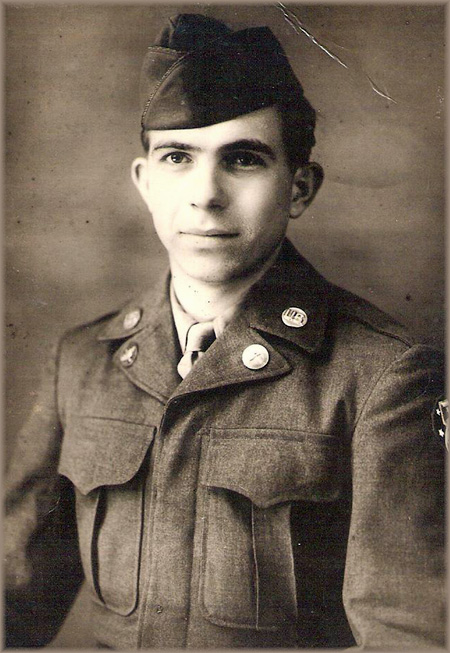
TL in militaryA lifelong friend died a few weeks ago.  Sergeant Tom Ennis, United States National Guard, passed from this life March 4, 2017.  He was 87 years old.  Just over a month earlier, I had written a blog recalling some of the memories of a lifetime friendship with him, his wife Nan, and their children Dennis, Stacey, Susan, Sharon and Samantha.  Tom was a member of The Greatest Generation, the Generation that literally went out and saved the world.  In the end, his eyesight had failed,  his body frail and wracked with pain.  Thankfully, he is now free of the pain and suffering he endured the last years of his life.

Tom, or Tommie, as I called him, was tough as nails.  A career soldier who worked in the motor pool at The National Guard Armory, he supplemented his income by working on VWs out of his garage.  I say his garage, but when I first met the family, Tommie worked outside in the driveway and beside the house in Gresham Park.  When they moved to a larger split level on the outskirts of Cedar Grove, he worked out of the carport.  I can still see him pulling into the driveway in whatever VW he was driving at the time, walking into the house in his green fatigues and boots, and saying in that deliberate, baritone drawl of his, “Nan, fix me a drink.”  It is ironic that his eyesight failed him, because his eyes were a deep piercing blue.  He had a non-fade tan and was lean and fit.  I’m sure in his youth he was quite strapping and handsome.  After retiring from the Guard, he rented a garage on Fairview Road about two miles from the house and worked out of there for ten or fifteen years.  I painted the sign for the shop when he opened it.  The slogan on the sign was “We Get The Bugs Out.”

Tommie, or Tom, or T.L., whichever you preferred (he went by all three), had a very… acerbic sense of humor.  Everyone had a nickname.  I was always just “Etheridge.”  My buddy Chip, all six foot two and two hundred twenty pounds of him, was “Tiny.”  One of our long haired Gresham Park friends, of whom Tommie was not particularly fond, was “Alice.”  There were names for others as well, but I won’t mention them.  Some were pretty embarrassing.  My father, whose name was Julian, became “Julie.”  That’s all he ever called him, and the two of them became very close friends in the last five years or so of my father’s life.  Daddy would go over and hang around the garage at least three or four times a week.  A lot of people did.  I stopped by one winter afternoon and Tommie told me my wife, Marie, “came a-wheelin’ in here the other day with the top down, wearin’ an overcoat, gloves and a big ol’ floppy hat, tellin’ me her car was a-makin’ a funny noise.  I said, ‘Hell, Marie, it’s a Volkswagen.  It’s supposed to make funny noises!'”  She left in a huff.  I went home and drove the car around the block and, I had to admit, didn’t hear anything other than the usual Volkswagen funny noises.  I drove down to the shop to tell Tommie.  “Etheridge, what are you doing driving The Nice Car?” he asked.  He always referred to the convertible as “The Nice Car.”  He did not refer to it as such due to its mechanical soundness or cosmetic beauty, either.

When I was drifting in and out of jobs in my late teens and early twenties, Tommie was always good enough to pay me a few bucks to help him out with the Bugs whenever he could.  “Oh, hell, Etheridge, you’ve got the damn thing in upside down…”  He taught me a lot about Bugs, but the most important lesson he taught me was that I was in no way cut out to be a professional mechanic.  He tried to get me to join The Guard.  He was always trying to get all of us to join the Guard.  What a motley crew that would have been.  Ultimately, he convinced me that it was in my best interest to go back to school and pursue a career in which my talents lay.

But, he did teach me some VW tricks that stuck.  He taught me about wedging a stick between the throttle and the carburetor, opening it up about halfway so you could get home after the accelerator cable broke.  He taught me a trick about how to get into a Bug in case (or with me, whenever) you locked your keys inside.  I’ll refrain from sharing that one, because I don’t want to encourage breaking and entering.  And, after I had to stop by and borrow his perpetually full five gallon military gas can because I had run out of gas, he advised me, “they’ll run a who-o-o-ole lot better if you put gas in ’em to start with.”

Another trick I saw Tommie use involved jumper cables and a lot of ingenuity.  During the ice storm of ’73, the power got knocked out.  Never mind the heat, stove, washer or dryer, the TV was out.  This was a disaster.  Undaunted, Tommie and his buddy G.C. climbed the pole out in front of the house and, using jumper cables, managed to jump the power from the main line to the line going to the house.  Problem solved.  The jumper cables stayed up there for months, until Georgia Power discovered them while doing routine maintenance.   
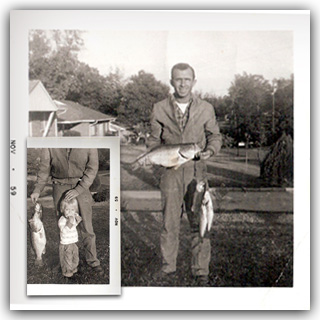
Tommie put up with a lot from us as kids, more than I ever could have endured.  Pulling in from work and there being four or five jacked up hot rods parked in and leaking oil on his driveway.  Walking into his house from work and Foghat blasting from the stereo.  Four or five teenage boys hanging around his swimming pool or running around his house in swim trunks.  No wonder he wanted Nan to fix him a drink.  I would have eventually gone postal.

Tommie never did.  As a matter of fact, beneath his somewhat gruff facade, you always knew he was kind, compassionate, and would do anything he could to help.  He helped me patch up my Bug countless times when I would come limping into the driveway in it.  He helped our friends David and Butch rebuild the transmission in David’s Porsche 912.  He kept Stacey and Samantha’s MG Midgets on the road.  When I was restoring our convertible, I sought him out for advice constantly and he gently walked me through many of the processes.  When it came time to paint it, he got me the paint at his cost from NAPA and let me paint it in the shop using his spray gun.  He showed me the basics and I painted it myself.  The end result was something less than even Earl Scheib would have been proud of, but it didn’t matter.  With Tommie’s help, I had painted the car myself.  I was thrilled.

As much as Tommie endured, he endured what is, to me, unfathomable.  He endured the loss of his only son, Dennis, in 1989.  Dennis was thirty three years old and killed in an automobile accident.  I have lost family and friends, but cannot begin to imagine the loss of a child.  Dennis, Stacey and I had been friends since high school, and that is how I became close with the Ennis family.  Tommie, Nan and the girls persevered and life, as it should, went on.  All these years later, it still seems surreal sometimes to me that Dennis is gone.  I can only imagine the hole that was left in the their lives.Dennis and TL

Dennis was absolutely and without a doubt the best mechanic I have ever seen in my life.  He could do anything he wanted.  He could change out a VW engine the way most people change underwear.  He once took a ’67 bus and cut the middle out of it.  Then he pushed it all back together, welded it up, finished it and it looked like a Balooney Toons Cartoon Car.  He built numerous dune buggies, both rail and fiberglass bodied.  He and Stacey and I went to Daytona one year for Spring Break in his 454 Monte Carlo.  On the way back the ignition coil (remember those?) went out somewhere on I-10 in the middle of nowhere.  Dennis and I left Stacey in the car with a blackjack, and walked about a mile and a half to the closest gas station.  They happened to have an old 350 engine out back and sold us the coil off of it for two dollars.  We walked back to the car and Dennis took the old coil off and put the new one on using nothing but a screwdriver.  Rather than try to put it in the mounting bracket without the proper tools, he laid it on top of the intake manifold, and off we drove.  We made it home without a blip.  A couple of weeks later, Dennis told me he had forgotten that the coil wasn’t in the mounting bracket until he opened the hood to replace his air filter.  He had driven it around for two weeks with it resting on top of the intake.  At the time he died, he was working on a Volkswagen limousine.  He was in the process of cutting a Bug in half.  He was then going to pull it apart, cut the middle out of another bug, and put it in the middle of the one he had cut in half.  There’s not a doubt in my mind he would have pulled it off perfectly, and it would have looked and driven like it had rolled off of the line in Wolfsburg.

The last time I saw Tommie was in the summer of 2016.  Jackie and I, along with Barry and Debbie Pratt, visited with him, Nan and Stacey at their house in Jackson.  It was a beautiful afternoon, and we spent several hours laughing and reminiscing about the old times.  As we were leaving, I told Tommie I loved him.  It was the first and only time I had ever done so.  I’m thankful now I had that opportunity.TL and Jimmy
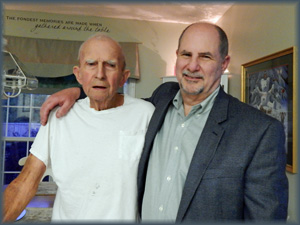
So, they are all back in the garage now.  They’re sitting around the pot bellied stove drinking coffee in the morning and beer in the afternoon.  Talking about VW’s, NASCAR, model airplanes and bass boats.  Other than Tommie and Dennis, ol’ Charlie is there.  G.C. is there.  Marie just wheeled in wearing her overcoat, gloves and a big ol’ floppy hat.  My father is there.  And, I like to think, someday I’ll be there.  We’ll all be there… Still Cruisin’!  –J.     


Whirlybirds | The Friendly Skies

Well,  Jackie and I went flying again.  And, no, it was not in a commercial airliner.  I said to her afterwards, “Do you realize we’ve flown together three times but never in commercial airliner?”  The Good Lord willing, we will finally experience The Friendly Skies together this summer on a trip to New England and Canada. 

In 2013, we flew together for the first time in a 1941 Waco biplane.  We sat side by side in the open cockpit.  Then, a year later, we went up with our friend Jerry in his 1963 Mooney.  Jackie got to sit shotgun, I was relegated to the back seat.  I say back seat, but it was more like the luggage compartment in a Karmann Ghia.  

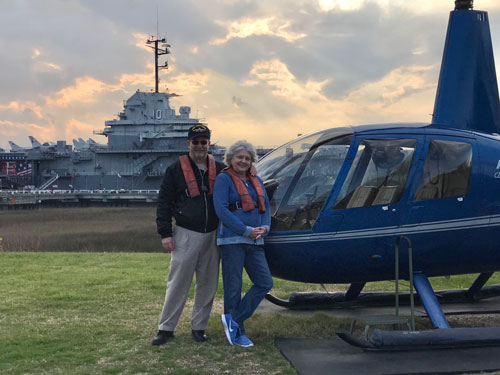
This time we went up in a helicopter.  A Robinson R-44 Clipper II, manufactured in Torrance, California, in the good old USA.  Again, Jackie rode shotgun, I in the back seat.  I complain, but I really don’t mind.  As long as I can see out the window, I’m happy.  We went up in February in when we visited the USS Yorktown at Patriots Point in Charleston.  We arrived early before boarding the ship, three hours early to be exact.  We saw the sign for Helicopter Rides when we pulled into the parking lot, then saw the chopper sitting on the grass pad.  I did my Eeyore imitation, droning, “They’re probably not flying today.”  Then I went into the gift shop and spent $60.  When I came out of the shop with my Yorktown cap and various other USN souvenirs, Jackie told me, “I talked to the pilot, they’re flying today.”  We walked down to the pad, and the pilot was a very nice young man who told us about the helicopter itself, the length of the rides and the rates.  “You want to go up?” I asked Jackie.  “Sure,” she said, so we walked back up to the gift shop to purchase our tickets.  As we walked back to the pad, adrenaline took over and I began to walk faster and faster.  I wasn’t quite running, but was close.  I’m sure I looked like one of those Olympic Race Walkers powering my way to the finish line, which in this case, was the helipad.  “Slow down, Jimmy, he’s not going to take off without us,” said Jackie.  “I know, but I don’t want anybody to jump ahead of us.”  I was convinced some interloper would push their way to the front of the line, even though there was no one within five hundred yards of us.

We went through the mandatory safety orientation with Young Pilot Rodney (his real name escapes me), then boarded the Clipper II.  As I said, Jackie rode shotgun, but she was in the left front seat.  Young Pilot Rodney flew the bird from the right seat.  I started to ask him if he was sure the chopper wasn’t built in England, but he didn’t seem to have much of a sense of humor.  We sat on the pad and waited for the rotors to get up to speed, then gently lifted off and began our trip around Charleston Harbor.  If you have never ridden in a helicopter, I would highly recommend you do so if ever the opportunity presents itself.  It is, as Young Pilot Rodney put it, “like riding a magic carpet.”  You are literally floating high above the landscape.  The power plant is behind you, the rotors above you and, even though we were wearing earphones, the ride was surprisingly quiet.  

We went out over the Crab Banks and Hog Island.  The Crab Banks are also a seabird sanctuary, and there were hundreds of gulls on the banks.  I didn’t see any hogs on Hog Island, at least not from the air, and I refrained from asking how it got its name.  We flew over Fort Moultrie and the mansions on Sullivan Island, then banked right and headed out across the bay to Fort Sumter.  We visited Fort Sumter the following day, so Young Pilot Rodney gave us a brief history lesson.  At the time of the Confederate attack on the fort, it was four stories high.  He also told us that the initial shots fired on the fort were fired from Fort Johnson, which is on a point about a half mile east from Fort Sumter.  I had always wondered about the cannons used to fire upon the fort and how they could have the firepower to shoot clear across the bay from Charleston and hit their target.  So that answered that question, and we continued on our excursion.  We then turned right and headed over the city, the pink and yellow houses of Old Charleston, Folly Island and the remains of Castle Pinckney.  We then circled around the Ravenel Bridge over the harbor, and Young Pilot Rodney pointed out the remains of a scuttled Confederate ship that was built out of concrete.  Yes, concrete, and apparently it actually did float.  From the ground it just looks like an old concrete barge or dock, but from the air you can clearly see it is the remains of the hull of a ship.  

We then landed, shook Young Pilot Rodney’s hand and thanked him for the ride.  Jackie had never been up in a helicopter before.  I had been up twice, both times in an early Sixties model Bell 47G.  These were the models with the glass bubble cockpit, the true Whirlybirds.  Riding in one of those is REALLY like riding on a magic carpet.  You are sitting two or three abreast in a glass bubble, and can see everything in front, beside and below you.  The first time I rode in one was when I was seven years old, with my father at the old Southeastern Fair.  The main thing I remember about that flight was flying over the old Funtown Amusement Park and seeing the Spinning Teacups ride below us.  I got a card that certified I was a Junior Whirlybird Pilot, and it stayed on the bulletin board in the kitchen of our house until we moved.  Thirty or so years later, in Panama City Beach, my brother in law and I rode the bicycles down to the Daiquiri Shack.  There just happened to be a helipad next door where you could rent rides on a 1963 Bell 47G.  After several daiquiris, we ponied up our fares and climbed aboard for a flight over the beach, banking left at Gulf Highlands Condos where we were staying.  We looked down and saw our wives and kids walking across the parking lot, headed to the beach with towels and coolers.  When we caught up with them later they told us they saw us fly over.  As thrilling as it is seeing things from the air, it’s really cool to see your family.  

The trip around Charleston was a wonderful surprise, and again I reminded myself about how lucky I am that Jackie has no qualms about climbing into a flying machine with me and taking off.  Next on my bucket list is to fly in a Huey.  Riding shotgun, mind you, not being airlifted.  Jackie wants to try skydiving next.  She may have to do that one on her own.  I can’t see bailing out of a perfectly good airplane.  Especially one that is… Still Cruisin’!  J.                     

Car Movies | Bullitt and Beyond

I punched up Facebook this morning and saw a post by my friend Rob that the ’68 Mustang 390 GT Fastback used by Steve McQueen in the chase scene from the movie “Bullitt” has been found in a Mexican junkyard.  Thanks for the post, Rob, because this week’s edition of Car Talk happens to be about car movies!  The Mustang was found by car collector Hugo Sanchez, who wanted to restore a Mustang into “Eleanor” from the movie “Gone In Sixty Seconds” starring Nicholas Cage.  Paint removal revealed the original dark green paint.  The VIN numbers were checked against the order numbers from Warner Bros. and found to be a match.  McQueen himself had searched extensively to find and purchase the car, which disappeared shortly after filming, before his death in 1980.  Sanchez plans to restore the car to its original state, and experts are hesitant to guess the Mustang’s potential worth.  Let’s just point out that one of the Dodge Chargers used in the movie went on sale for a cool mil in 2013.

I have to admit I really don’t remember much about the movie other than the chase scene, which is arguably the best of all time.  I do know it was not a car movie but a detective movie.  McQueen’s name was Bullitt, and he was protecting a Mafia witness, I think.

Speaking of the movie “Gone In Sixty Seconds,” I really didn’t care much for the remake.  Maybe because I’m not really a Nicholas Cage fan, but to me the 1974 original was much better.  First of all, they changed the name, spelling out “Sixty” as opposed to the number “60”.  Not that that makes a lick of difference, but if you’re going to copy something, copy it right.  Second, the original had a budget of $150,000.  Granted, this was ’73 when the film was made, but it was still low-budget.  The film grossed $40,000,000 in 1974 dollars.  The 2000 remake had a $90,000,000 budget and grossed $101,000,000.  Even I can figure out the profit margins there.  Third, the original was just a lot more fun to watch.  The second half of the movie is one long car chase that has to be seen to be believed.  The funniest part of the entire movie was a group of black teenagers riding around smoking weed and drinking Coors beer in a beat up old Cadillac, which eventually catches fire while they are riding in it.  

And, speaking of Coors beer, no car movie discussion would be complete without mentioning 1977’s “Smokey and the Bandit.”  Filmed in and around Atlanta, it starred Burt Reynolds as The Bandit, Jerry Reed as Cledus and Jackie Gleason as Sheriff Buford T. Justice.  SATB was a huge box office hit in ’77, second only to “Star Wars.”  The movie had a budget of $4,000,000 and grossed almost $127,000,000.  (Thanks to IMDB for these figures.)  Not a bad profit margin.  Remember, these were the days before video, Netflix and Hulu.  If you liked a movie, you would see it in the theatre more than once.  I saw SATB five times.

A friend of mine owned Fred, the basset hound in the movie.  His real name was Happy.  John’s mom saw a classified ad (remember those?) for a casting call held at Stone Mountain.  They were trying to find the ugliest dog they could.  She took Happy to the audition, and he was supposedly picked by Burt Reynolds himself.  The story is that Reynolds wanted to mess with Jerry Reed and picked Happy because of his refusal to obey commands.  After the movie came out, I was visiting John and petted Happy.  He is the first and only movie star I have ever petted.

John made it into the film as an extra.  When Cledus gets beat up by the bikers in the bar, he is one of the members of the motorcycle gang and is clearly visible in several shots.  My buddy Jimmy and his cousin Redus are in the movie as well, by nothing but chance.  They were leaving for a job from their overhead door business one morning, heading up Stone Mountain-Lithonia Road.  Filming was going on at the cemetery at Phillips Road.  Their truck wound up right behind Sheriff Buford T. Justice’s car in the funeral procession scene.  Theirs is the white Ford truck behind the patrol car, and you can clearly see Redus looking out the driver’s window into the camera.  Only the outline of Jimmy’s head is visible due to the shadows.

For me, the whole car movie thing started with Robert Mitchum’s 1958 moonshining epic, “Thunder Road.”  I first saw it at the Madison Theatre sometime in the Sixties, and my cousin Dennis and I would see it every time it played there.  It is the story of Lucas Doonin, a Korean War vet now running the family moonshining business.  Mitchum wrote the story as well as the theme song.  The chase scenes are remarkably well done for the time, and I can only imagine driving a souped up 1950 Ford with no power steering through the twisting Appalachian roads at night.  Ol’ Luke would have left the Fast and Furious guys in his dust.  The role of Robin, Luke’s younger brother, was offered to Elvis Presley, but Colonel Tom demanded more money than the producers were willing to spend.

Speaking of Elvis and The Madison Theatre, I then moved on to Elvis movies.  At the Madison, I saw pretty much every Elvis movie ever made.  A number of his movies were car and motorcycle themed.  The best, in my opinion, was “Viva Las Vegas” featuring Ann-Margaret.  As I have mentioned before, Elvis could ride down the road on a motorcycle or in a convertible, burst into song and be accompanied by a full band, without his hair ever getting messed up.  The King was the coolest. 

“Two Lane Blacktop” starring James Taylor, Dennis Wilson, Laurie Bird and Warren Oates was released in 1971.  Taylor and Wilson, known only as The Driver and The Mechanic, are street racers that drift from town to town looking for action.  They pick up Bird, known only as “The Girl”, in a diner in Flagstaff.  They meet up with a middle aged braggart driving a 1970 GTO Judge in a gas station in New Mexico, and agree to race to Washington D.C., title for title.  Rather than traveling the interstates they decide to stick to the backroads to attract less attention from police.  Hence the name, “Two Lane Blacktop.”  Apparently music rights have prevented this movie from being released into the video market, and it is rarely seen today.

The iconic “Easy Rider” was released in 1969 and became an instant classic.  Written and produced by Peter Fonda and directed by Dennis Hopper, the film stars Fonda, Hopper and a young Jack Nicholson.  Fonda and Hopper are two counterculture bikers who, after a big score, ride from California to New Orleans for Mardi Gras.  Along the way they pick up Nicholson, a young, alcoholic lawyer.  It is a landmark film and is still relevant today.  I had a huge poster of Peter Fonda from the movie on the wall of our garage, which was odd because I was not allowed by my father to see the film.  This was due to the fact that they “smoked mary-wanna in it.”  It didn’t make any difference later on, but I did not see the movie until 1984.  We had just gotten our first VCR, and a friend of mine taped it for me off of HBO.

1973’s “American Graffiti” was an important film in so many ways.  At the time of its release, the only well known actor in the cast was Ron Howard.  The movie launched the careers of such actors as Richard Dreyfuss, Harrison Ford, Cindy Williams, Suzanne Somers, Mackenzie Phillips, Paul LeMat, Charles Martin Smith and Candy Clark, to name quite a few.  It was directed by a young upstart named George Lucas and produced by Francis Ford Coppola.  The beautiful canary yellow 1932 Ford Coupe driven by John Milner (Paul LeMat) is my favorite hot rod of all time.  The car is owned by Rick Figari of San Francisco and, along with Paul LeMat, regularly makes appearances on the car show circuit.  Another interesting note is that the ’55 Chevy driven by Harrison Ford in the movie is the same car used in “Two Lane Blacktop.”

Finally, I must mention a personal favorite, 1980’s “The Hollywood Knights.”  The movie is basically a cross between “Animal House” and “American Graffiti.”  Set in 1965, it chronicles the high jinks of a Southern California car club on Halloween night.  Their hangout, Tubby’s Drive-In, is being torn down the next day to make way for a new office complex.  The film features a fantastic soundtrack and, like “American Graffiti,” was the first film for several young actors.  Tony Danza was the only established star in the cast.  The rest of the cast includes a very young Michelle Pfeiffer, Fran Drescher and Stuart Pankin, whose character Dudley Laywicker makes Flounder from “Animal House” look like The Fonz.  The real star of the movie, however, is Robert Wuhl as Newbomb Turk.  This was Wuhl’s first film, and his character Newbomb is loud, crass, funny and clueless in his relentless pursuit of girls.  Newbomb is at constant odds with Officer Bimbeau (Gailard Sartain) for having his brother’s El Camino, whose care Newbomb has been entrusted with, impounded.  Despite the sophomoric pranks, the film also deals with deeper issues of the looming Vietnam War, moving from adolescence into young adulthood, and inevitable change beyond one’s control.  There are many beautiful cars featured, including “Project X,” a canary yellow 1957 Chevy driven by Danza’s character, Duke.

These are but a few, and there are way too many great car flicks to mention here.  From the A-listers to the B-movie classics of the drive-ins, celluloid and gasoline seem to go hand in hand.  And thanks to today’s technology, a lot of the movies are only a click away.  Punch up “Duel” on YouTube.  It is a 1971 made for TV movie starring Dennis Weaver.  It was directed by a young unknown named Steven Spielberg and takes road rage to the ultimate level.  

That’s it for this week.  Car Talk is at its “Vanishing Point!”  …Still Cruisin’!  –J.       


Special Edition | Happy Birthday, Dana!

Welcome to a Special Edition of Car Talk!  Today is my daughter Dana’s birthday.  I am not going to say which one, because it is impolite to reveal a lady’s age.  Nor will I reveal the birth year because those of you less mathematically challenged than myself could figure it out.  Suffice it to say it was sometime in the early Eighties.

I remember that day and the days and weeks leading up to it like it were yesterday.  Initially, it did not appear as if I were going to be much, if any, help in the delivery room.  Dana was born at Piedmont Hospital, and her late mother Marie and I went through the Lamaze classes as was recommended by the obstetrician.  We learned the pattern breathing, the prenatal exercises and massages, etc.  Then one evening we were told to report the following week to room such and such for the child birthing movie.  We arrived late due to our work schedules, and the only seats available were two at the very back.  The room was one of those auditorium type science lecture classrooms with a faucet and sink, chalkboard and movie screen at the front.  So, sitting on the back row, we were at the top against the back wall.  This turned out to be a blessing in disguise.

The movie started simply enough, but then got graphic in a hurry.  Very graphic.  I’m talking absolutely nothing left to the imagination graphic.  Now, I do not handle blood or needles very well at all, and soon began to feel very lightheaded.  I told Marie I didn’t feel very well and she told me to close my eyes and lean my head back on the wall.  I did so, but then she started giving me a play by play of what was going on in the movie.  I said, “Marie, shut up, please.  I told you I don’t feel good.”  The next thing I knew I was coming to, leaned up against a pregnant lady with light brown hair and glasses, to my left.  Funny, I still remember exactly what she looked like.  She was pushing me back up and Marie was pulling me.  I had fainted dead away.  Marie looked at me and said, “Oh, I can see you’re going to be a lot of help in the delivery room.”  I leaned back in my chair with my head against the wall and eyes closed for the rest of the movie.  It had a happy ending, a new little boy named Scotty was born.  Funny, I still remember his name…

On Friday, March 11, a booming pregnant Marie called me at work around noon.  “It’s time,” she said, and I left work amid cheers of congratulations and good luck from my co-workers.  We went to the doctor’s office at Piedmont, and the OB/GYN told us, “You’re only dilated maybe one centimeter.  Go somewhere and walk for a couple of hours and that should help accelerate the process.  We went to Lenox Square and walked up and down the mall for two hours.  Eventually, we both agreed we were tired and went home.  When we got to the house, I grabbed the softball and the gloves and said, “Come on, we’re going out in the backyard and play catch.”  We played catch for about an hour before Marie had to go in and sit down.  We ate dinner, watched TV and about 11:00 pm went to bed.

I was awakened around 12:30 am by her poking me in the shoulder.  “It’s time,” she said, “it’s really time.”  We grabbed our pre-packed suitcase, jumped into my ’73 Ford Ranger pickup and took off for Piedmont.  We were flying up I-75, rhythmically breathing the whole way.  We checked into the hospital.  The nurse assigned to Marie was named Cookie.  She looked like a nose tackle, but was very compassionate, soothing and comforting.  “Don’t you worry, Sweetie, we’re gonna bring that new little baby into the world tonight,” she told Marie.  She stayed with us the whole night.  She held Marie tight as they were administering the epidural.  And yes, she was in the delivery room when Dana was born.  When Dana was a month old, after her first checkup with the pediatrician, Marie went to the hospital and found Cookie.  She hugged her, thanked her and gave her flowers from her garden.  Cookie held Dana.  Later we talked about what a wonderful job that must be, bringing new little babies into the world.

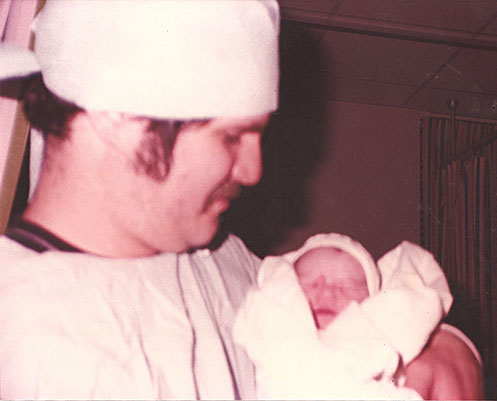
When the time came and we were taken into the delivery room, the doctor put a stool for me at his end.  Marie said, “Oh, no, he has to sit up here with me behind the curtain.  He faints.”  During the delivery, between breathing and pushing, she kept looking up at me and asking “Are you okay?  Are you okay?”  At one point, the doctor stopped and said, “Wait a minute.  There’s something wrong with this picture.  HE’S supposed to be asking YOU if YOU are okay!”  We all had a laugh, and about fifteen minutes later, after one final push, the doctor exclaimed, “There she is!”  At 5:50 am on March 12th, Dana Marie Etheridge brightened up the world.  I jumped up and ran around to look at our new daughter.  Marie warned me to be careful, I might faint, but at that point it didn’t matter.  I was oblivious to everything but my beautiful little girl.  They laid her on Marie’s chest so she could hold her, then the doctor asked if I wanted to cut the cord.  I thought about it for a second and said, “No, you’re the doctor.  I’d rather you cut it.”  Marie asked him to cut it so Dana would have and innie as opposed to an outer.  The doctor told her all he could do was cut it, and then whether it was an innie or an outie was out of his control.

The picture above was taken by Cookie right before Dana was taken to the nursery.  It is the first picture of us together.  Keep in mind we were running on no sleep, so after Marie was taken back to her room, I went home to get some rest.  Mother and Baby rested at the hospital on Sunday, and on Monday, a warm and sunny early spring morning, we brought Dana home.  Not without incident, however.  When I got to the hospital, Marie asked me, “Where’s the car seat?”  When I left the house to drive to the hospital, I was so excited I jumped in the car and completely forgot it.  Those were the days when you were not required to have one to take a new baby home, so we rode home with Marie holding Dana.  She kept warning other cars to get away from us and to stay off of our bumper.  Dad drove the speed limit the whole way, feeling like the most forgetful, idiotic husband and father in the whole world.

Years later, my granddaughter Brooklyn was born.  When Jackie and I saw Brookie for the first time in the hospital cradle, I lost it.  She was Dana all over again.  It took several minutes before I could compose myself.  Dana had had a C-Section, so she had not seen her daughter yet.  I was blessed and honored to be able to take my granddaughter into the recovery room and hand my daughter her daughter for the very first time.  Full circle, and it was a very emotional moment, to say the least.

Happy Birthday, Puddin’!  We’ve had our times, but I am thankful and proud of the beautiful young woman and mother you have become.  Your Poppy always has and always will love you.  Here’s to many, many more… Still Cruisin’!  –P. 

Going Mobile | Music and Driving

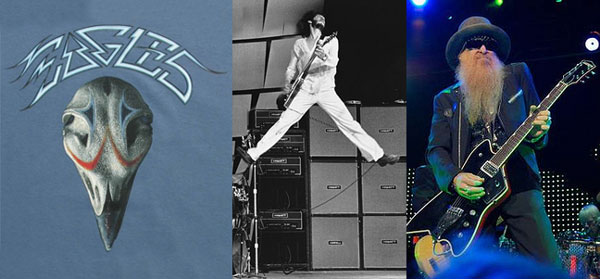
My three favorite bands of all time are The Eagles, The Who and ZZ Top, pretty much in that order.  I have been fortunate enough to see each of them in concert.  The Who in 1975, featuring the original lineup with drummer Keith Moon, ZZ Top thrice and the Eagles at Piedmont Park in 2010.  Though the list has changed throughout the years, these three have always been favorites and I have always loved their music.

Especially when driving.  What is it about music and, as ZZ puts it “that wonderful feel of rolling in an automobile”?  Maybe it’s the motion, the music or both, but they go hand in hand like Lester and Earl, Fred and Ginger, Snowman and The Bandit.  When listening to a song we love we tend to speed up, sing along and play air guitar.  Or, in my beloved Jackie’s case, air drums.  If you ever see her on the road and she’s flailing her arms, she’s not having a conniption.  Well, if I’m driving maybe, but most likely she’s just playing along with the Allman Brothers.

In the waning years of my adolescence I got into progressive rock.  It was all Yes, Emerson, Lake and Palmer, The Moody Blues and Jethro Tull.  In my early to mid twenties, it was Southern Rock and The Rolling Stones.  In my late twenties to early thirties, I really got into Springsteen and John Cougar.  I know he goes by his proper name Mellencamp now, but to me he’ll always be John Cougar.  

And all on 8 track tape.  For those of you too young to remember, 8 track was groundbreaking technology.  All of a sudden you could listen to music you chose and not AM radio.  FM radio did not gain a mainstream foothold until the early Seventies and even afterward, the 8 track market thrived because we could listen to whatever we wanted whenever we wanted.

The first 8 track tape decks appeared in Ford Mustangs, Thunderbirds and Lincolns in 1965.  By the end of the Sixties, the tape market was booming.  I owned a Ranger Mini-8, which featured a knob labeled “Fine Tuning” on the left hand side of the face of the player.  It adjusted the head of the player and eliminated “double tracking” which 8 tracks were notorious for.  This was ingenious, and I could never figure out why this feature wasn’t available on all players, auto or home.  The Mini-8 was the only unit I ever saw it available on.  Maybe Ranger had a copyright on it… 

Let me explain double tracking.  8 track tapes had four channels the songs were spread over.  Generally there were three songs on track one, three on track two, etc.  Double tracking was the annoying, or maybe infuriating is a better word, phenomenon of hearing the music from a track faintly, or not so faintly, in the background while you were listening to another track.  There were tricks to eliminate it, such as running through all the tracks quickly back to your original track.  But, the most common and effective method was sliding a closed matchbook cover, small side first, under the tape.  This wedged the cartridge up on the head and eliminated the double track.  High tech, but it worked.  Most of the time, anyway…

My friend Dennis installed automotive sound systems for a living.  I owned a ’73 Super Beetle, and he talked me into letting him put a Pioneer AM/FM 8 track player and a pair of speakers called Mind Blowers in it.  These things had a booster switch and when you hit it, it would literally rattle the glass of the airtight Bug.  It’s a wonder I didn’t destroy the hearing of myself and several of my friends with those things.  

The players were notorious for eating tapes, and when the inevitable jam happened, you had to remove the cartridge and pull the tape itself out of the player, sometimes tearing or having to cut the tape to get it out.  This usually resulted in the tape being tossed, but not in my circles.  My buddy Walt became known as “The Tape Doctor”, because he could pretty much fix any 8 track cassette.  Torn or cut tape, no problem.  He could patch it with Scotch tape and it worked seamlessly with just a blip in the music at certain points.  He was a true Seventies 8 track genius.  If Walt couldn’t resurrect your tape, there was no hope.  Once, my Pioneer ate my Pink Floyd tape.  I gave it to Walt, and when I met up with him a few days later he said, “Hey, I got your tape fixed,” and handed me a Herb Alpert and the Tijuana Brass cartridge.  I looked at him and he said, “Don’t worry, I had to break the cartridge getting the guts out.  The Tijuana Brass was an old broken one of my dad’s.”  It worked perfectly, of course, and when my friends were looking through my tape box, they’d pull it out and bust out laughing.  “The Tijuana Brass???” they would snicker and sneer.  I’d pop it in, “Breathe” from The Dark Side Of The Moon would come floating out of the speakers, and that would be the end of that. 

8 tracks eventually gave way to cassettes, cassettes to compact discs, compact discs to mp3s, AM radio to FM, FM to iTunes and Sirrus XM Satellite radio.  But through it all, we have continued to rock while rolling.

And it seems like certain music goes with certain types of travel as well.  I used to have to endure trips from Atlanta to Texas with my parents listening to elevator music.  That’s an experience I would not wish on anyone, particularly since we had to make the trip at 65 mph.  If my father hit 70, my mother would come unglued.  I always loved listening to the Eagles and Southern Rock riding through the country on sunny afternoons.  Going into town to hit the Mad Hatter or the dance clubs, it was always Rod Stewart, The Doobie Brothers or The Stones.  Riding around on rainy days with my buddy Chip, we liked to listen to the Who and Pink Floyd.  And for a night of beer drinking at Shakey’s or Manuel’s, it was always Hank Williams, Waylon Jennings or Willie Nelson.  For road trips to Florida, I always liked The Allman Brothers or ZZ Top’s “Tejas”, an underrated album which in my opinion is one of, if not in fact, ZZ’s best.  On a date, whatever you wanted to listen to was out the window.  It was whatever she wanted to hear, although Fleetwood Mac was always the best go-to music, if the opportunity presented itself.  I had to endure whole nights of the Carpenters or Chicago as well, but I drew the line at Helen Reddy.  I only went out with one girl that wanted to listen to Helen Reddy.  She brought along her own tape.  We only went out once.

Like most Boomers, my taste eventually evolved into what became known as “Classic Rock”.  This was simply the music we grew up with but, at least in my opinion, it’s better than anything that’s being produced currently.  I created my own CDs with music downloaded from Napster, LimeWire and iTunes.  But, CD technology is fading.  I don’t have an iPad or any other such device.  We have Sirrus radio, but over time you realize that, like the FM stations and iTunes radio, they play the same stuff over and over again.  The one station I really enjoy on Sirrus is Willie’s Roadhouse, which features the old time legends of Country music.  George and Tammy, Ray Price, Loretta, Conway and all the greats.  None of the bad pop that Country music has become.

So today, I do something I was genetically incapable of in my youth.  I pretty much ride in silence.  My car and my van do not have Sirrus.  There is one Classic Rock station in Atlanta, and with the exception of Kaedy Kiely, it is terrible.  In the morning, I listen to WSB to get the traffic and the weather, then turn it off before it gets into who said what or who shot whom.  But every now and then when the mood hits me, I’ll pull out my Who, Eagles, ZZ Top or one of my mixed CDs.  I’ll put it in and crank it up.  Just me, my music and the road… Still Cruisin’!  –J.  


The Mad Hatter | Penny Beer Night

My friend Gary from Southwest DeKalb recently posted a Facebook thread on The Mad Hatter.  Boy, now that was a place that if the walls could talk, what kind of stories they could tell!  Actually, I suppose the walls can talk because everybody who went there on a regular basis or even only once has a story about the place.  

The Mad Hatter was located in old Underground Atlanta, although it actually was not in Underground per se.  It was located in the top of one of the old warehouses at the corner of MLK and Central Avenue.  For about five years, it was THE place to be on Wednesday, Friday and Saturday nights.  I’m not sure if it was even open any other nights of the week.  Fridays and Saturdays there was a one dollar cover charge, beer was seventy five cents a cup and mixed drinks a dollar and a half.  Wednesday night was Penny Beer Night.  We’ll get back to that later…

All the high school alumni in South DeKalb had their hangouts.  Walker, Gordon and Cedar Grove’s was Mother’s Pub in the back of South DeKalb Mall.  Southwest DeKalb’s was Bud’s Picnic in Chapel Hall shopping center on Wesley Chapel Road at Snapfinger Woods Drive .  Columbia and Towers alumni frequented The Keg on Glenwood Road just inside of Columbia Drive.  We all visited each other’s establishments as well.  I’m not sure about other schools in the area, but these are the ones I remember.  

But EVERYBODY went to the “Hatter”.  Often times you would meet up with others at the above mentioned watering holes before heading downtown as a group.  You would walk up two flights of stairs to get to the front door.  Three City of Atlanta police officers worked the Mad Hatter.  Officer Cochran carried a pearl handled revolver on his left hip.  The other two officers were Officer Drummond and Officer Pope.  It helped to get on a first name basis with them.  One of the officers would check your ID.  You would then pay your cover charge and they would stamp your hand to show you had paid.  You were then free to enter and dance the night away. 

The ID check was a science all its own.  I would hazard a guess that on any given night, probably a third of the crowd in the Hatter was underage.  The ink they stamped your hand with took days to wear off, so some would try wetting their hand and then rolling the hand of someone whose hand had already been stamped over their own.  This worked sometimes, particularly on the nights they stamped your hand with the number “8”, which would transfer correctly if you could get it to work.  This method was dicey, at best.  The best method was License Alteration.  

I never could figure out why, but they would accept the paper temporary driver’s licenses that were issued as valid forms of ID.  These were very easy to change.  A clean eraser, a sharp #2 pencil and a steady hand were all that was needed.  You would erase the last digit on the birth year, pencil in the updated digit and suddenly the bearer was two years older and legal.  Occasionally the exam date would have to be updated as well, but once you got the hang of it, it was easy pickings.  The light was low at the ID checkpoint, and though the officers used flashlights, a decent alteration would get you right in.  Since the statute of limitations has probably expired, I suppose it’s okay to divulge the following information… I did this for a couple of friends.  Once it became known I was proficient at it, I did a few more for five dollars apiece.  Five dollars was enough for Penny Beer Night with a dollar left over.  Penny Beer Night… we’ll get back to that later.

Upon entering, you would take a right, and the bar was straight ahead against the far wall, which wrapped around to the back wall at the left.  To the right were tables with a path in the middle leading to the elevated and lighted dance floor.  To the left was a supporting post covered with shag carpeting and television screens scrolling through photos taken of the patrons on different nights.  Some nights the last thing you wanted was to have your picture taken… If you continued straight you would come to the door of a small staircase leading to the bathrooms downstairs and a back exit.  People would try to sneak in the back exit, but this generally never worked because there was a bouncer stationed down there with big arms and a small sense of humor.  You were better off ponying up the cover charge and entering through the front.

Above the dance floor were the speakers, the DJ and a miked drum set.  A drummer would play along with the music.  One night after I arrived at the Hatter, a friend I had not seen in a while, David Haney,  came running up to me.  David was a professional musician even then, and he was the last person I ever expected to see in The Mad Hatter.  He told me the regular drummer was a friend of his and had asked him to sit in for him that night.  I remember how cool it was dancing, looking up and seeing David playing the drums.  While on the dance floor, it was inevitable you were going to hit a slick spot and slip.  This was due to spillage from people taking their drinks up on the floor with them.  When you hit a slick spot, you would either fall on your butt or appear to be busting a move, depending on your luck.

The carpet in the Hatter was red shag.  I don’t know if they ever had a carpet cleaning company come in and clean it, but it certainly didn’t appear as such.  If so, they probably would have needed hazmat suits.  From night after night of drinks and Lord knows whatever else being spilled, it became so sticky that your platform shoes stuck to them as you tried to walk.  The only other place I can compare it to is the Madison Theatre in East Atlanta.  I am convinced that when they removed the carpets from the Madison and the Mad Hatter and burned them, that is what cause the hole in the ozone layer.

Penny Beer Night… as I stated earlier, Fridays and Saturdays the cover charge was a dollar.  Wednesday night was Penny Beer Night.  The cover charge on Wednesdays was the then astronomical sum of three dollars each, but draft beer was a penny apiece.  The cups were large green and white paper cups filled with draft beer that I’m convinced had been brewed that morning.  You’d put a dollar in the big jar at the bar and you were good for the night.  Mixed drinks were a quarter.  You could also get an Original Mad Hatter Wine Cooler for a quarter.  An Original Mad Hatter Wine Cooler was Boone’s Farm Strawberry Hill served over crushed ice in one of the large green and white paper cups.  Bottoms up…

I’m not sure how many people would be in the Hatter on any given night, or what the capacity might have been.  But things would get tight, very tight.  Given the amount of alcohol, cigarettes and polyester in the place, to say it was a fire hazard would be the understatement of the century.  And yes, there were fights.  Lots of them actually.  You can’t have that many hormones fueled by cheap beer in tight quarters such as the Hatter and there not be some sort of altercation.  I managed to avoid them myself, but managed to see some pretty good fisticuffs over the years.  

On Wednesdays they closed at 1am.  I would leave about midnight or so and go home.  I would get a few hours sleep, wake up, shake my head, take a cold shower or just stick my head under the faucet.  I would throw on my clothes, jump in my Mustang and be at work by 8am, good to go.  If I did that now, I’d be in traction for a week, either from drinking, dancing or both.  But back then, owing to youthful stupidity and tolerance, by lunchtime I was a new man.  Ready to go back and, to quote Peter Frampton, “Come On, Let’s Do It Again!”… Still Cruisin’!  –J. 


My Dune Buggy | Manxpower

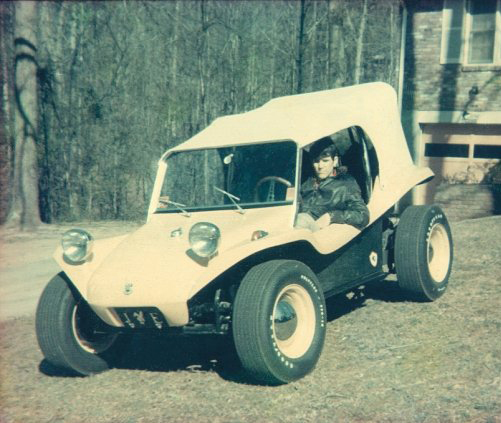
The lines between my first car are a little blurred.  Technically, it was a 1956 Volkswagen Beetle.  In reality, I suppose, it was a 1969 Meyers Manx Dune Buggy.  The ’56 was torn down and my father and I built the Manx from that.  It was a clone of the Manx body, built by George Howell of Howellcraft in Atlanta.  George was a boat builder by trade, and his shop was on Pryor Street at University Avenue.  I always called the car a Manx.  A ’69 Meyers Manx just sounded way cooler than a ’69 Howellcraft.

The Manx was a street buggy, and a beautiful one, if I say so myself.  It featured, among other things, custom leather bucket seats, plush carpeting, a custom cherry wood steering wheel, custom built wide VW wheels so no adapters were necessary, chrome baby moon hubcaps, Goodyear Polyglas F70-14 tires, a Ranger Mini 8 eight track tape deck mounted in the dash and a vintage Model A Ford Oogah horn operated by a button on the dash board.  The power plant was a 40-hp VW engine beefed up to at least 60 hp with chrome headers, a high lift cam, a competition clutch and a roller crankshaft.  The transmission was a modified bus transmission with the gear reduction boxes removed from the transaxle.  The car would only do 70 mph top end, but it would get there in a hurry.  I found out later it would yank the front wheels up off of the ground in first and second gear.  This would prove to be my undoing.

It took my father and I three years to build the car.  We started in the late spring of ’69 and the car was finished in early ’71.  The dark green ’56 Bug the car was built from was purchased from Jeff Saunders, who was three years ahead of me at WHS and lived on Parker Ranch Road off of Gresham.  We got the car in the winter of ’68.  We used it as is for a few months and one Sunday my father took me out to the dirt road construction area where Clifton Springs Road was being extended to Panthersville Road.  He put me behind the wheel, taught me to drive it in one afternoon and I’ve been a Bug Man ever since.  I was thirteen years old and at the end of the day he let me drive home.  Times were a lot different back then.

The truth be known, I became attached to the little ’56 and really did not want to tear it apart for a dune buggy.  I asked my father if we could just keep the Bug, but he told me no, “we” would rather build a dune buggy.  But that is another kettle of fish for another day.

As I said, the car was finished in early ’71.  I knew it would be a shoo-in for Car Of The Month at Walker, but it never happened.  I never got to drive it to school.  It sat in our garage with the key in it.  To a fifteen-year-old boy chomping at the bit to drive, this was torture.  I asked if I could drive it back and forth to school and was told no, I had to wait until I was sixteen.  Both my parents worked, so I would come home each day and look at the dune buggy sitting there ready to go.  Finally, temptation got the best of me and I could stand it no longer.  At school I told my buddy Chip to come home with me that afternoon, we were going riding in the dune buggy.  We drove it all over Gresham Park for a week.  Cruising McDonald’s and Dairy Queen, taking girls for rides, having a blast.  However, being the geniuses that we were, we never thought to unhook the speedometer to keep the miles off or use our lunch money to put gas back in it.  My father eventually figured it out and that is when the proverbial excrement smote the oscillating cooling device.  My learner’s permit was snatched from me.  I was put on triple secret probation.  Anybody and everybody within an earshot was treated to the story of what a juvenile delinquent I was for taking the dune buggy out for springtime afternoon joy rides.

The stocks were eventually lifted from my neck and wrists.  I got my driver’s license and a job as a Petroleum Transfer Engineer at Parks American Station at Flat Shoals and Fayetteville Roads.  I made $1.50 an hour, about 60 bucks a week.  I thought I was rich.  I could fill the buggy up for $2.50 and spent the rest on movies, clothes, eight track tapes, McDonald’s hamburgers and Dairy Queen shakes.  I taught a girl how to drive in it on Cottonwood Drive.  I also bought a year’s membership to Clifton Springs.  That was The Beginning Of The End.

Somewhere around that time, someone who was not really a reliable source told my father that a certain type of contraband was being offered for purchase in the Gresham Park Dairy Queen parking lot. Hence, I was forbidden to go to the Dairy Queen. My father’s description of the alleged transactions was not so eloquent and he would tell anyone and everyone who would listen. One afternoon I was at the DQ in my dune buggy, leaning against the fender and talking to a few of my buddies. My father rode by and saw me. The bright yellow Meyers Manx with the white convertible top was hard to miss. He whipped his truck into the parking lot, screeched to a stop behind us and jumped out. He yelled for me to “get that thing home with my [gluteus maximus] in it right now!” He glared at my friends like they were useless reprobates and climbed back into his truck. He backed up and waited for me to pull out. To say it was embarrassing is an understatement. He followed me home and when I climbed out of the dune buggy he slammed the door to the truck, poked his finger in my chest and said that he had told me about hanging out in that “blankity blank slop chute” and if he ever saw me there again he was “first gonna whip whoever’s [gluteus maximus] I was with and then he was gonna whip mine.” I always wondered if he would whip one of our defensive ends’ [gluteous maximus], had I been there with one of them. I still went to the Dairy Queen, but I didn’t drive the dune buggy there anymore.

One Sunday afternoon Chip and I were at Clifton and I was bragging that the dune buggy could do wheel stands.  No one believed me and I was challenged to prove it.  So, we climbed in the buggy with a small crowd gathered ’round.  I got it rolling backwards down the hill, revved up the engine and dumped the clutch.  The front end jumped off the ground and we tore off up the hill.  I hit second and the front end popped again.  Take that, doubters and scoffers!  We took a left, buzzed into the subdivision across the street and roared up Weslock Circle.  As I slowed for the stop sign at Clifton Springs Way, Chip looked at me and said, “Now look in your rear view mirror.”  My father was flying up behind me in the Fairlane, hanging out the window screaming at me to “take that @#$$%^! thing home!!!!”  “I’ve got to take Chip home first,” I called back.  “Well, take his @$$ there, then get yours home!!!”  I found out later the old man made a habit of following me from a distance.  How else would he know I was doing wheel stands at Clifton Springs and just happen to come riding up behind me?  Anyway, when I got home, my mother told me my father was in the basement waiting on me.  I went downstairs and he demanded my driver’s license.  I gave it to him and he tried to rip it in half.  He couldn’t and I laughed.  That was the wrong thing to do.  But, he looked funny trying to rip a laminated plastic license in half and turning blue in the process.  When I laughed, he looked at me with his eyes on fire and his face turning a deep purple.  He snatched up a pair of tin snips and cut up my license into confetti.  Then he yelled something about there it was on the floor, and my @#$$%^! future along with it.  He stormed out, presumably to go smoke a half a pack of Lucky Strikes at once.  That was the last time I ever drove the dune buggy.  It was sold within two weeks.  I got my license back and bought a Pinto.  It didn’t explode, but after about a year the transmission fell out and I sold it to the man across the street. 

I saw the dune buggy again, however, about four years later.  A friend and I had been at the Mad Hatter in Underground Atlanta one Saturday night.  His girlfriend lived in Gold Key apartments in Riverdale and we dropped her off.  Sitting in the parking lot was a yellow dune buggy.  “That dune buggy looks kind of like mine.  I’m going to check it out,” I told Don.  I walked over and looked in through the side curtain.  The instrument cluster was identical to mine, and holding the speedometer in place were the bronze bolts with the custom “JE” heads daddy and I had made.  I ran around to the front and there on the nose was the Etheridge Coat of Arms I had painted on the nose.  It’s visible in the photo above.  It was my dune buggy!  I’d had more than my share of Mad Hatter draft beer that night, but there was no doubt it was my Manx.  We rushed to my house and I stormed into my parents bedroom and woke them up.  “I saw the dune buggy, I saw the dune buggy!!!”, I kept yelling.  My old man looked at me like I was out of my mind.  The next day I told him, “I know you don’t believe me, but that was the dune buggy I saw.  It had different wheels, but the “JE” bolts and the Coat of Arms were there.  It was ours.”  He still didn’t believe me and said something about my state at the time impairing my ability to recognize anything.  But, no ifs ands or buts, that Manx sitting over in the Gold Key parking lot was once mine.

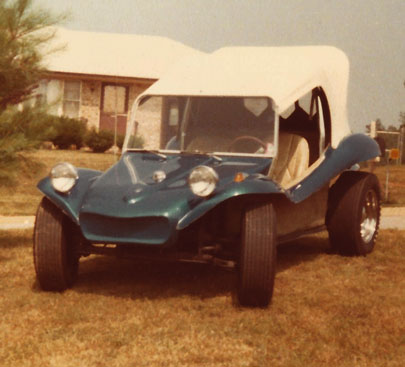
I bought a Bug my junior year at Walker. It was a pale green ’63 model and remains the best bargain I have ever had in a car. I bought it off of a buddy for seventy-five dollars. I tinkered with it, drove it to school a couple of days a week and even went out on a few dates in it. Then I let my father talk me into using it to build another dune buggy. I resisted at first, but he kept at me and I eventually caved in. He built a beautiful metalflake blue street buggy and then wouldn’t let me drive it. When I did, the car went through a fifty-six-point inspection when I got home. The final straw was the day Chip and I took it for a Sunday drive and drove the car down a few dirt roads. I didn’t fishtail it or aim for potholes, but I did bring it home with a little bit of mud on the tires. My old man went ballistic. He was convinced that Chip and I had taken it out trail riding and railed accusatory profanities at me. That was the last time I drove it. I just decided that a few hours of fun driving it wasn’t worth the abuse when I got home.  It sat parked in the carport in Rex for about six or eight months.  Every once in a while if I was headed out on a Saturday or Sunday afternoon, Daddy would ask if wanted to take the dune buggy.  I always politely declined.  He finally sold it.  No more Cruisin’. Especially at Clifton Springs.

USS Yorktown | USS Laffey

We spent last weekend on The U.S.S. Yorktown in Charleston Harbor.  It was a deeply moving experience because, you see, Navy blood runs very deep in my family.  I did not serve, and if I could go back and change that fact, I most certainly would.  However, my father served in WWII, as did three of my uncles.  Jackie’s dad served as well.  My late nephew Kevin served with honor, God Rest His Soul.  My step-brother served on the U.S.S. John F. Kennedy, and I have a second cousin currently serving.  Navy blood runs deep, indeed.

Jackie’s grandson Gavin is in the Cub Scouts, and the Coastal Carolina Council and Patriots Point have partnered to host numerous events for the Boy Scouts.  We found out in November that Gavin’s pack was making the trip in February.  Jackie found out grandparents were welcome to stay on board as well, so this trip was my Christmas present.  

If you ever have the opportunity to visit the Yorktown, it is not one to be missed.  To board a WWII era aircraft carrier, spend the night on her an explore her was, for me, a once in a lifetime experience.  The women slept in the officer’s quarters with three bunks to a room.  The men’s quarters were more spartan.  In fact, it resembled a cow pen.  Imagine seventy five bunks stacked four high in a forty by twenty foot room, half occupied by grown men and the other half seven and eight year old boys.  We shared one head with six johns, sinks and showers.  I will say, however, the showers were roomy.  Not like a cruise ship where you can’t turn around without the shower curtain visiting uninvited places.  The hot water taps worked as well, and not just for a few seconds.

We ate galley food, served on a tray.  Breakfast consisted of bacon, scrambled eggs, a cinnamon roll and coffee.  Lunch was ham sandwiches with potato chips and a cookie.  Dinner was chicken or pork barbecue, baked beans, potato salad, rolls and tea.  In the weeks leading up to the event, I was hoping for authentic Navy food served on a shingle… 

Upon boarding her and looking around, my first reaction was, “How can something this big float?”  The trip is geared toward experiencing the daily lives and routines of the sailors, pilots and officers who served on board.  On the flight deck are some of the more modern jet aircraft, including an F-8 Crusader, an F/A-18 Hornet and, of course, a “Top Gun” F-14 Tomcat.  On the hangar deck below, however, is where the history lives.  Preserved perfectly are numerous WWII aircraft including a B25 Bomber flown by the legendary Jimmy Doolittle, an F6F Hellcat, an SBD Dauntless Dive Bomber and my personal favorite, an F4U Corsair.  I was struck by the size of the fighter planes.  They are large and tall, almost as large as the B25 Bomber.  The 2000 HP Pratt and Whitney rotary engines necessitated a much larger front fuselage than I had imagined.

On Saturday we took the ferry out to Fort Sumter in Charleston Harbor.  It was freezing cold with about a 40 mph wind.  The Scouts helped unfold the flag, and four of us helped raise her.  And in that wind, it took all four of us to get her up there.  It was one of the most moving experiences of my life.  I helped raise the flag on Fort Sumter.  The American flag, the way God intended it to be.

The Yorktown on display at Patriots Point is the CV-10.  The original U.S.S. Yorktown CV-5 was lost in The Battle of Midway June 7, 1942.  The CV-10 was under construction at the time, and was named the Yorktown to honor the lost CV-5.  She is the fourth U.S. Navy ship to bear the name.  They say she is haunted and they do ghost tours on her as well.  I suppose every warship is haunted in some way, particularly those that served in WWII.

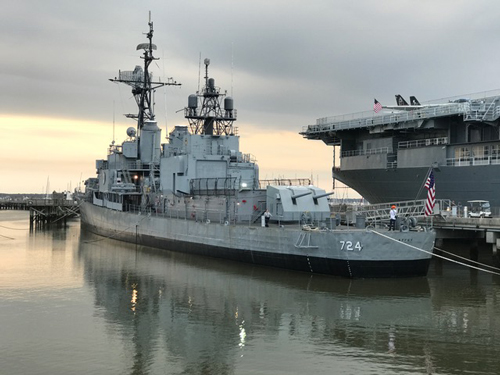
And probably none more so than the U.S.S. Laffey DD-724, a destroyer docked in Patriots Point as well.  April 16, 1945 off the coast of Okinawa, she withstood an attack by Japanese dive bombers and one of the most, if not the most, unrelenting kamikaze air attacks in history.  Hit by four bombs and six kamikaze crashes she remained afloat, earning her the name “The Ship That Would Not Die”.

I toured the Laffey Sunday morning.  We had departed the Yorktown and had breakfast at the Sea Biscuit Cafe on Isle of Palms.  Afterwards, Jackie insisted we return to Patriots Point so I could tour the Laffey and the U.S.S. Clamagore,  a submarine also docked at Patriots Point.  I was alone on the ship.  Touring her, I came to really understand the bravery of the young enlisted men and officers who served not only on her, but in all branches of the service.  I thought of J.B., Jackie’s dad, a lot.  He served on a destroyer, the U.S.S. Providence.  I watched the video of the attack and two of the men who survived were interviewed.  One was eighteen years old at the time, the other nineteen.  I know where I was when I was eighteen and nineteen and it sure as hell wasn’t fighting a war in the Pacific.  There were no safe spaces and the only trigger warning was a 5000 lb. Japanese Zero closing in with the intent on putting all of you and himself at the bottom of the sea.  Not just any day, but any moment could be your last.  A friend once said of the generation who served in WWII, “They literally went out and saved the world.”  That they did, and truly earned the name “The Greatest Generation.”

To the brave young men and women who served and are serving now, God Bless You All.  To those who paid the ultimate price for our freedom, my gratitude has no words.  I am thankful and honored to have been able to walk in your footsteps aboard the vessels on which you served.  God Bless You All.  God Bless America.  God Bless The United States Armed Forces.  And, God Bless The United States Navy.  Anchors Aweigh, My Boys, Anchors Aweigh…  –J.

Tommie and Nan | A Lifetime Together

I recently read a quote by Canadian author Nadia Scrieva that states, “Each meeting occurs at the precise moment for which it was meant. Usually, when it will have the greatest impact on our lives.”  I remember exactly when I met the Ennis family.  It was in the autumn of 1971, and they would become like a second family to me.  Tommie, Nan and their kids have had a profound impact on my life.  Probably as much as, and in many ways more than, my own parents.

I went to school with their two oldest children, Dennis and Stacey.  They were one and two years behind me, respectively.  Stacey and I became friends at school.  The Ennis’s lived in our neighborhood, at the other end of Rollingwood Lane in Gresham Park.  I began to visit their house on a regular basis at first, quickly evolving into every day.  They put up with me and never told me it was time for me to leave…

I suppose every neighborhood has a house that all of the kids naturally gravitate towards.  That house was always Tommie and Nan’s.  I have never in my life known two more gracious, kind, unselfish and patient folks in my life.  Lord knows they put up with a lot of crap from us.  There are more stories than I could ever fit into this space here.  Some should not be repeated, so I will touch on some of the ones that hopefully can be…

The Ennis’s were a Volkswagen family.  Tommie was a soldier, a career National Guardsman who worked in the motor pool at the Armory on Confederate Avenue in East Atlanta.  Like a lot of guys back then, he worked on VWs in his driveway in his spare time and on weekends.  I would hang out there while he worked on them.  This was one of the main reasons I developed a lifelong love for The People’s Car.  

They raised five wonderful children.  Dennis, Stacey, Sharon, Susan and Samantha.  Samantha was only two or three at the most when I got to know the family.  My friend Barry and I ran into her at Taco Mac Trivia Night several years ago.  She slapped me on the back and said, “Hey, I just turned 40 a couple of weeks ago!”  I looked at her and said, “Oh, hell no… you can’t turn 40.  You’re not allowed to turn 40!”  After she left and went back to her friends at their table, I looked at Barry and asked, “Now, does that make you feel freakin’ old or what?”

In the summer of 1972 the Ennis’s took a vacation to Panama City and invited myself and two other friends to go along with them.  They rented one of the old cinderblock houses that used to be on the beachfront.  It was next to the Holiday Inn and a few blocks down from The Miracle Strip.  It wasn’t until I was grown that I realized the magnitude of that undertaking.  I can only imagine taking four teenagers and three kids to the beach for a week.  Tommie sat on the back porch, drank beer and smoked Kools, then went to the dog track at night.  I understand why…

Nan is without a doubt one of the funniest women I have ever known, always smiling with an infectious laugh.  She always treated us teenagers and young adults as an equal.  I considered her one of my best friends even back then.  I had to go to summer school in the summer of ’72 and take a math class.  It didn’t help any, but that’s beside the point.  Tommie had bought a ’67 VW bus to fix up and sell.  I had a Ford Pinto, and at least twice a week, I would leave the house in the morning, go over to the Ennis’s and ask Nan if I could drive the bus to school.  She always let me, and that’s probably one of the reasons why today I covet a ’67 Bus…

They moved from Gresham Park to South DeKalb in early ’73, about as far south as you could go in DeKalb County.  Their new house was a split level brick on Linecrest Road, which straddled the DeKalb/Henry County line.  Tommie converted the carport into his workshop and was finally able to work on the Bugs while protected from the elements.   About a year later they put in an in-ground pool.  In the basement room that opened to the pool was a refrigerator that was always full of beer.  It may have been 3.2 Old Milwaukee from the Fort Gillem Class 6 store, but in the middle of July on a Sunday, it didn’t matter.  It was beer, and it was cold.

One Saturday morning in 1974 I was sitting around the pool with Nan and the younger kids.  We were listening to the radio, and they played Ray Stevens’ song, “The Streak.”  The kids disappeared inside, and we hear this giggling and laughing from The Basement Room With The Refrigerator.  All of a sudden Sam, the youngest, comes running out of the room naked as a jaybird.  Her two sisters, fully clothed, were right behind her screaming and laughing.  She makes a couple of laps around the pool.  Nan and I were cheering and howling with laughter.  Tommie came running down to the pool from the garage, and he wasn’t laughing.  He yelled at Sam, “Get in that house and get your clothes back on!!!”  Then he looked at Nan and yelled, “What’s wrong with you, anyway???”  She tried to look serious, and he stormed away.  As soon as he left we fell out laughing again.

Nan introduced me to Mountain Oysters.  I was over at the house one Saturday, helping Tommie with the Bugs.  At lunchtime, I walked in the kitchen and Nan was sitting talking to her friend Janet, who worked for a local vet.  There were two pork chops sitting on a plate on the counter.  I asked Nan, “Can I have one of these pork chops?”  She looked at Janet and grinned and said, “Sure, go ahead.”  I ate the pork chop and said, “That was pretty good, can I have the other one?”  They both fell out laughing.  I stood and looked at them and asked, “What’s so damn funny?  I just asked for another pork chop.”  “It’s not really a pork chop,” said Nan, “it’s a Mountain Oyster.”  “What the hell is a Mountain Oyster?” I asked.  She told me and I must have turned forty shades of green, from chartreuse to deep forest, because they started laughing even harder.  I ran out of the house holding my mouth, leaving them reveling in their jocularity.  The vet Janet worked for had been hog hunting, you see.  If you don’t know what a Mountain Oyster is, Google it…

Tommie and Nan have been married sixty six years now, a lifetime.  I don’t see them as often as I should or would like, and that’s my fault.  But I love them both deeply, and that will never change.  They have touched not only my life, but the lives of so many of the kids, teenagers, young adults and adults who grew up in Gresham Park and Cedar Grove.  I thank God that in His Infinite Wisdom he crossed my path with theirs.  It is a gift for which I am forever grateful.  Sixty six years… Still Cruisin’!  –J.

Panthersville | Friday Night Lights

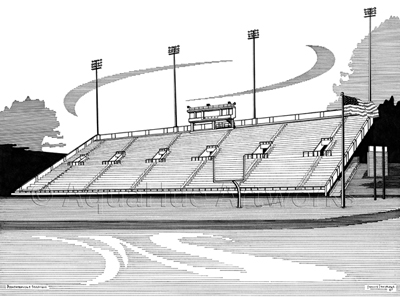
I am stepping outside the box here.  This week’s blog is not about anything with wheels, a propeller or a rudder, but a football stadium.  Not just any football stadium, but Panthersville Stadium.  

Panthersville is the area in South DeKalb County, Decatur, Georgia stretching west from the intersection of I-20 and I-285 to Flat Shoals Road, Clifton Church Road and the South River.  Southwest DeKalb’s team name is the Panthers, and the original school building is at the corner of Flat Shoals Rd. and Panthersville Rd.  

For years the question has been, at least for many of us, as to whether Panthersville was named after the Panthers, or vice versa.  According to an article by Andy Johnston published in the AJC 10/5/15, it was vice versa.  Panthersville was likely named after a big cat.  The article states that “In a letter dated Dec. 20, 1939 Scott Candler, DeKalb County’s Commissioner of Roads and Revenues, explained the origin of the name, as recorded by Vivian Price in “The History of DeKalb County”.  A family named Johnson (or Lochlin) lived where Blue Creek flows into the South River (near the current intersection of Panthersville Rd and Oakvale Rd.).  Their son, daughter-in-law and infant grandchild were leaving the area, headed back to their home in Decatur when a panther started to chase them.  The area just south of Panthersville on the South River was a swamp, and the commissioner hypothesized that even then, development was pushing wildlife onto the unusable land.  “I know of no better explanation of how Panthersville District secured its name,” Candler said in the letter.*

One last note; I’ve always wondered about the name “Southwest DeKalb” since the school, at least the original, is located in southeast DeKalb County.  My guess is that at that point in time, DeKalb County beyond Panthersville was pretty much wilderness.  So it was, in fact, southwest DeKalb.

Back to Panthersville Stadium.  Built in 1968, Panthersville was originally shared by five area schools, Walker, Southwest DeKalb, Columbia, Gordon and Lithonia.  On Friday nights for so very, very many of us, this was The Center Of The Universe.  Panthersville was dedicated September. 27, 1968.  Walker and SWD played the first game ever played there, with SWD winning 35-26.  The very next morning, at 8:00 a.m. Walker and SWD’s Eighth Grade teams played the second game.  I don’t remember the score, but Walker won on a goal line stand at the end.

For a kid who had only played ball two years at Gresham Park and the rest of his games in Buddy Bryan’s side yard, playing in Panthersville Stadium was mind boggling.  We rode a bus to the game.  The stadium had real locker rooms.  There were mostly only parents, grandparents and a few kids from school in the seats for those eighth grade game, but that didn’t matter.  You were playing for Walker High School.  This was the big time.  

A friend played at Stockbridge High in the mid-80s.  They would travel to Panthersville to play Walker, who was in their region at the time.  Stockbridge was still playing in the old stadium behind the school on North Henry Boulevard.  Sloan said playing in Panthersville was like playing in Texas Stadium.

On game nights, pretty much every kid, parent and teacher was in the stadium, on the sidelines or on the field.  The cheerleaders cheered, climbed the pyramids, dropped, flew and were caught.  The bands marched and played, the drill teams performed with precision.  The majorettes twirled fire batons.  We crowned homecoming queens, sometimes in the driving rain.  And we played football, both in the stifling heat and humidity and in the freezing cold.  It was The Center Of The Universe… 

The cross country team ran their meets before the football games.  Four laps around the track.  We used to go to the stadium in the summer and run the steps.  Back in those days, it was pretty much left open all the time.  We would play pick up games there on Sundays.  The pick up games were brutal.  Full speed, full contact football without any pads.  It’s a wonder someone didn’t get killed.  We used to shoot model rockets off the field in the off season.  No one cared, no one called the cops.  The Center Of The Universe…

The first game of my 10th grade season,  we were playing Southwest DeKalb in a B-Team night game.  It was the first game I ever started, at center.  While we were warming up, I saw an ambulance coming down Clifton Springs Road and turn into the stadium.  I didn’t think twice about it.  There was more important business at hand.  At halftime, not long before we were going back out, one of the managers yelled, “Etheridge!  Somebody wants to see you at the door.”  I went to the door, and it was George Ware, a kid who had lived up the street from us in Gresham Park, but moved to Panthersville a few years earlier.  His parents and my parents were good friends.  “Jimmy,” he said, “I just wanted you to know that your father had a heart attack before the game started and Horis Ward came and got him.”  Horis Ward owned a funeral home on Candler Road, and also owned an ambulance service.  This was in the days before EMTs.  As it turned out, they had taken him to Crawford Long Hospital, but I didn’t know that.  For all I knew, he was on a slab at the funeral home.  Five minutes later I was standing on the 40 yard line getting ready for us to kick off.  I was numb, shocked and frightened, but as soon as the whistle blew and Mark Clem kicked the ball, I tore off down the field, screaming like a banshee.  I took out three guys and hit the ball carrier at the 25.  He went one way and the ball went the other.  They recovered, but we went on to win.  

Fast forward to my senior year.  The last game of the season, the last organized football game I would ever play.  We were ready to take the field against Avondale, a perennial powerhouse.  The seniors were all honorary captains.  We were to lead the team on the field and participate in the coin toss.  As we were leaving the locker room, screaming and hollering and ready to play, my father pulled me to one side.  He had hired Mr. Wilson, our chemistry teacher and school photographer to take my picture.  I had to stand there while Mr. Wilson adjusted the settings on his camera and my teammates ran past me. I was bouncing up and down, back and forth, ready to go.  Mr. Wilson raised his camera and my father said, “Smile, Jimmy.”  I didn’t, and as soon as Mr. Wilson snapped the picture I was gone.  I ran down the stairs as fast as I could in my cleats.  The seniors were already huddled with the refs at midfield.  I ran straight there, feeling every eye in the stadium was on me.  I was embarrassed and pissed.  

The stadium has since been re-named, honoring a legendary coach at Southwest DeKalb.  That’s great, but as one of my teammates and I were discussing at a reunion last year, Panthersville Stadium was shared by four schools other than SWD.  Actually, five, once Cedar Grove High was built.  To those of us who played and performed, won and lost, celebrated and cried on that field, it was and always will be Panthersville Stadium.  Friday Night Lights, The Center Of The Universe… Still Cruisin’!  –J.

NOTE: Prints are available of the above pen and ink.  16″ x 12″, $20 plus tax and shipping.  Click here to order: 

PayPal - The safer, easier way to pay online!

*Published in The Atlanta Journal-Constitution October 5, 2015.