The Beautiful Silence

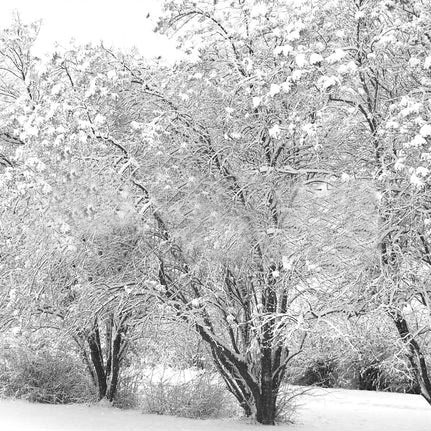
It was five o’clock on a late January morning. Outside it was bitter cold. There was ice in the treetops, on the cars, on the deck, the walkway and the steps. There were icicles hanging from the gutters on the house and the bird feeders in the yard. It was dead still outside. There was no sound of traffic on the main road a mile away. No wail of sirens. No cars going up and down the street, subwoofers thumping. No garbage trucks noisily making their pre-dawn collections. Not even the lonesome sound from the horns of the freight trains passing through town. And best of all, no dogs barking next door.  

The man lay still in bed listening to the quiet. For almost an hour he did not move. The sound was his favorite in the world. He listened to it intently. The silence. The beautiful silence. The silence reflected peace and tranquility. The silence encouraged introspection. The silence was spiritual.

The only activity outside was the birds. The man had filled the seed and suet feeders the day before. The flocks came in for the food that the cold ground and vegetation could not provide. He could not hear them, but he knew they were there. They too were quiet. It was as if the entire world was cold, calm and hushed.

The beauty and the still of the winter storm would be gone in a day or so, possibly by that afternoon. Though the temperatures would remain hovering at or below freezing, the sun would come out. The ground would warm and the ice would melt. The cars would begin moving up and down the street, in and out of the neighborhood. The traffic on the main road a mile away would return, along with the sirens and subwoofers. The trains would moan up and down the tracks, the trash collectors would resume their morning rounds, the neighbors would venture outside with power equipment and the dogs next door would return to their incessant barking. Life would return to normal, whatever that might be.

But for now it was still and soundless. The silence was majestic. The silence was fleeting. And it was beautiful. The beautiful silence.  
Me And My Aero | Thanks, Randy!

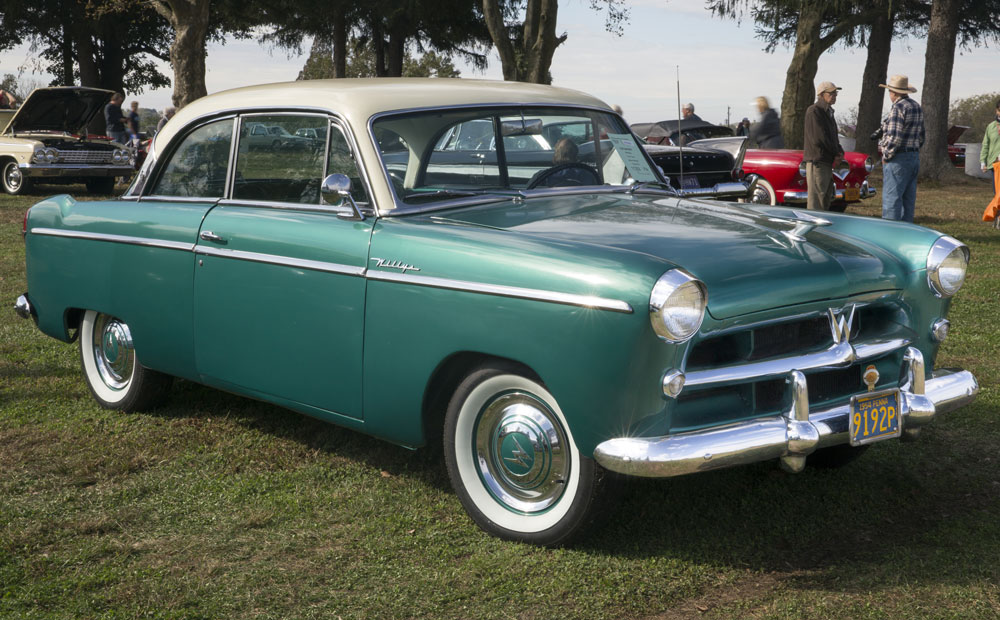
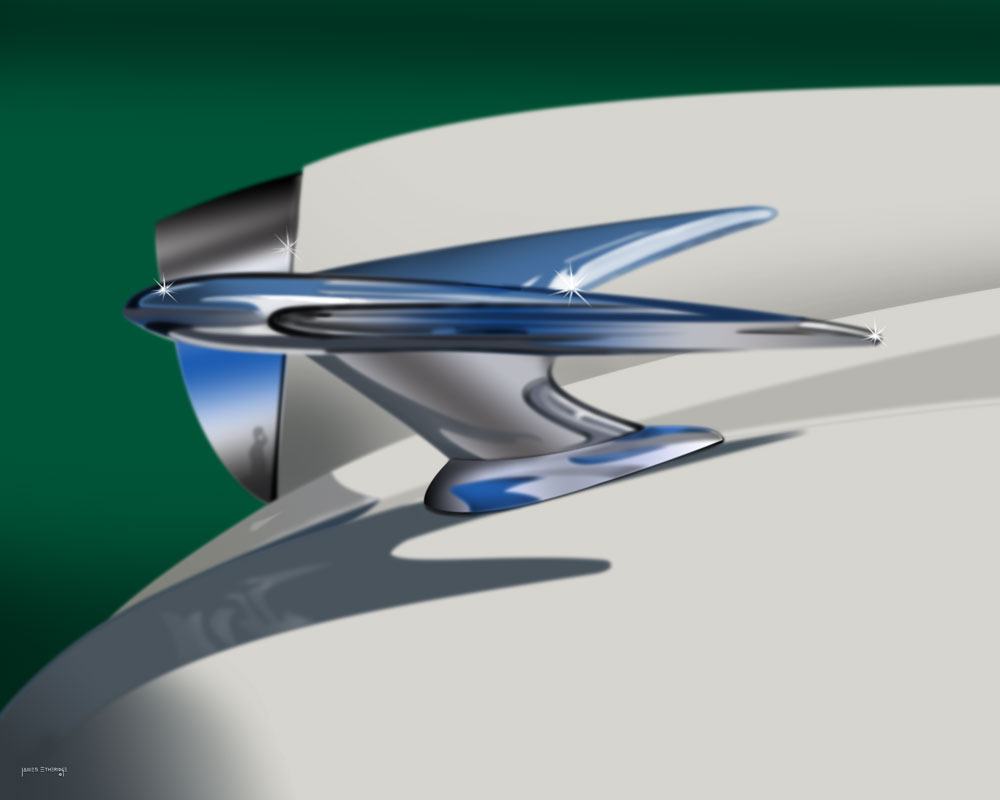
My latest, painted from a picture Jackie took years ago at the Oakland Cemetery Fall Festival.  I had wanted to paint the car for a long time, mainly because I liked the simplicity of the picture, the lines of the hood and fender and especially the hood ornament.  It was not a hood ornament that I recognized and even after extensive research, I could not find the manufacturer.  I wanted to know what kind of car I was painting, so I contacted my good friend Randy Chance.  Randy is a savant who I honestly believe knows the make and model of every car and motorcycle ever built.  I sent him the picture of the hood and ornament and asked him if it was something he recognized.  Within five minutes he wrote back and told me that the car was a mid-50s Willys Aero.  I called Randy immediately.  When he answered, I simply said, “You are a genius.”  I meant it.  The Aero was a sedan built by Kaiser from 1952-1955.  Production ended after the ’55 model year because Kaiser wanted to concentrate solely on Jeeps.  That may have been a good decision in the long run, but no Jeep ever had a hood ornament that looked as cool as the Aero’s!

1954 Willys Aero Eagle Hardtop


JC Whitney Catalog | Winky The Cat

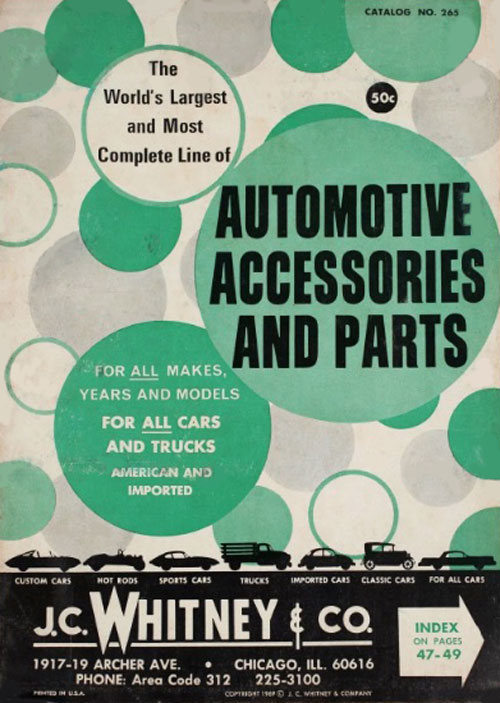
When I was thirteen years old, I discovered two magazines. The first was one my friend Billy and I found under my father’s bed, the name of which goes without saying. The second was the JC Whitney Catalog.

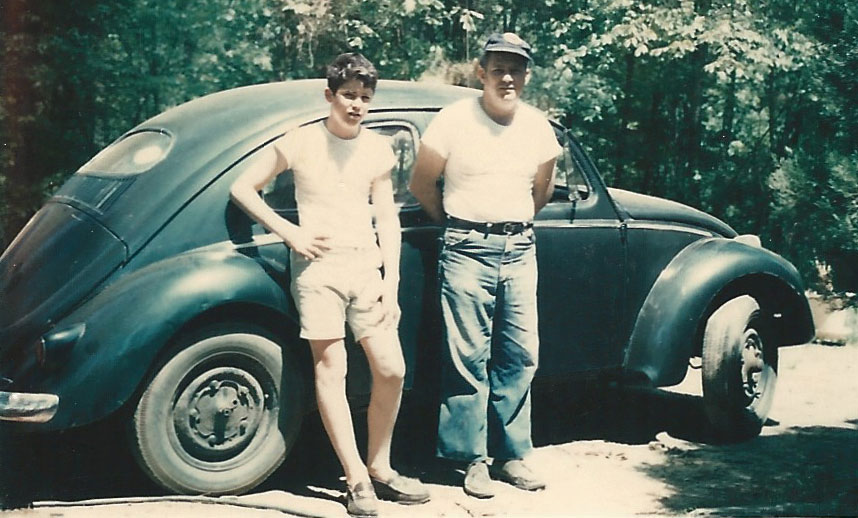
Thirteen was the age I became enamored with Volkswagens. My father bought a dark green ’56 and that was the beginning of a lifelong love affair with The People’s Car. Not long afterwards he drove up to the drugstore in Gresham Park for a pack of Lucky Strikes and brought home a Whitney Catalog. JC Whitney was a mail order house in Chicago that specialized in automotive parts and accessories. All of the parts were aftermarket, but it didn’t matter. They fit, they worked and they cost about half of what original equipment parts cost.

For a thirteen-year-old boy chomping at the bit to learn to drive and infatuated with all things automotive, the JC Whitney catalog was like the Sears Christmas Wish Book, only better. A new catalog was published every quarter. The Wish Book only came out once a year. Although I, like every other kid on the block, had eagerly awaited the Wish Book’s arrival in the mail every September, I was now a maturing young man of thirteen. I was more interested in girls, sports, cars, clothes and cologne, pretty much in that order. I had outgrown most of the juvenile merchandise available through the Sears Christmas catalog. The JC Whitney Catalog had become my new Wish Book.

And what a Wish Book it was! Virtually every part for every car built in the United States was available through Whitney, even complete engines. Aside from the usual array of tires, batteries and mufflers, the JC Whitney catalog offered a plethora of hood scoops, wheel covers, spoilers, fender flares, seat covers and just about every body part for a vintage Jeep or Volkswagen Beetle that was merely a phone call or mail-order form away.

Along with the legitimate parts, the catalog also contained a wide array of some of the most wonderfully wacky and tacky add-on gadgets you could imagine that could turn any ordinary car into a custom cruiser. First, there were the horns. Crazy horns that made all kinds of sounds, such as ship horns, ooga horns, animal sound horns, wolf whistle horns and musical horns that could be set up to play anything from La Cucaracha to Dixie. The animal sound horns included one that “whinnied like a real Mustang” and a donkey horn that would “Hee-Haw” to get attention. Here are a few of the other non-factory installed conveniences and luxuries that were available:

Automotive Radio Phone: This device predated the cell phone by at least two decades. Likely sold to make even factory workers feel like overpaid executives behind the wheel, it essentially turned a car, truck or boat into a low-power radio station that boasted a range of up to 10 miles.

Dashboard Record Player: I’m not kidding. Before the 8-track tape deck, this was the only option other than the radio. The catalog claimed it “performed smoothly over rough roads, curves and even during fast starts and stops”, although I seriously doubt it.

Deluxe Left Foot Accelerator: Not your standard left foot accelerator, but the deluxe model. I suppose the idea was that a driver’s right foot would get tired over a long trip, so he or she could simply switch over to the left foot. It’s a good thing this feature never became mainstream.

Door-Re-Mi Door Chime: Whenever a car door was opened, an enchanting melody of Do-Re-Mi, Let Me Call You Sweetheart, I Love You Truly or Ave Maria was played loudly. If you were a teenager, you could forget abut sneaking out at night or coming home late undetected with this alert installed.

Fuzzy Car Muffs: A short-lived craze where people dressed up their rides by wrapping fuzzy white fur over rear-view mirrors, steering wheels, dashboards, visors and rear window panels. It made a car look like a rolling den of iniquity.

Steering Wheel Spinner Knob: This gadget allowed one-handed driving, allowing the suave and debonair driver the ability to hold a lit cigarette or drape an arm around a date’s shoulders. The problem was that the knob only clamped onto the steering wheel, so if it came loose it would remain in your hand while the wheel snapped back into whatever position it desired.

Gyroscopic Stabilizers: “Calibrate the gyroscopic stabilizers, Mr. Scott!” This gizmo allegedly increased tire life, automatically balanced wheels, ironed out bumps and improved handling. Yeah, right.

In-Car Coffee Maker Kit: This was an actual factory option for Volkswagen Beetles in 1959. The Whitney version secured to the dashboard and plugged into the cigarette lighter outlet. Unfortunately neither the travel mug nor cup holder had yet been invented, so we can only imagine the pain and danger of suffering a lapful of hot java while operating a moving automobile.

Whitewall Kit: This kit turned your Fisk Retreads into high-end sidewalls. I would hope that not many people expected paint-on whitewalls to look as good or last as long as the real thing, but at least Joe Lunchpail’s Chevy could have whitewall tires just like the Joneses Continental.

Volkswagen Hand Starter: Don’t laugh. I had one and it worked. No jumper cables on board or the starter conked out? No sweat, just wrap the strap around the generator pulley and give it a yank, lawn mower style. Hey, at least it got you home or to the VW garage on the corner.

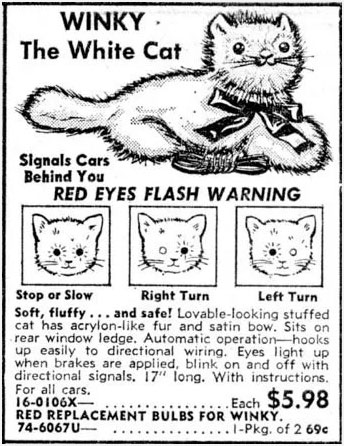
And finally there was Winky The Cat: Winky was a stuffed cat that sat on your car’s rear window deck. He was wired to your lighting system and had eyes that blinked if you were turning left or right. Both eyes came on when you applied the brakes. Tacky as it was, it was actually a precursor to the center high-mounted brake lights now required on all vehicles. Not a cat person? No problem, you could also order Mac The Dog or Duchess The Tiger.

Not all the accessories Whitney carried were tacky, of course. My ’56 VW was outfitted with a very nice walnut shifter knob with a clear acrylic dome over the shift pattern diagram and matching walnut dash knobs. It also had black cutpile floor mats, front and back and black vinyl seat covers, all from the catalog.

The last time I ordered from Whitney was in early 1990. My friend Frank, who owned a body shop, kept my ’69 VW convertible over the winter. He stripped the paint down to the bare metal, fixed a few dings, primed and painted it. He also put new floor pans in, which I had ordered from Whitney and had them shipped to the shop. He told me the pans were likely not going to fit exactly and he would probably have to do some cutting to make them work. A few days after they arrived, Frank called me up. “You’re not going to believe this,” he said. “Those things dropped in perfectly. All I had to do was weld them in.” He sprayed undercoating on the bottom and top of the pans and they have been in the car ever since, without a hint of rust or deterioration.

JC Whitney was acquired in 2010 by CarParts.com. The name does continue as a digital publication at jcwhitney.com, but in name only. The old catalog is just a distant memory, a memory that harkens back to simpler age and time, a time of do-it-yourself auto repair and customizing. A time of a young teenager dreaming of all the cool stuff with which he was going to turn his first car into a cruising vessel. It was all right there in the JC Whitney catalog. And my father didn’t have to keep it hidden under his bed.

The Roads Less Taken | Georgia Back Roads

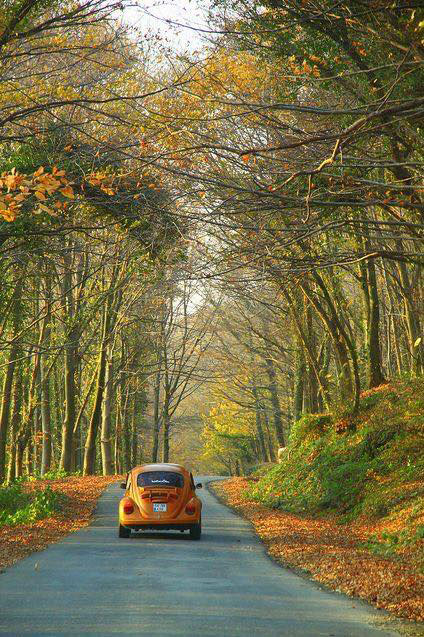
I love the back roads. I much prefer them to the big highways and especially the interstates. They are more pleasant, less stressful, more scenic for the most part and many times, it takes about the same time to get from Point A to Point B as it takes using the big roads. Driving in Atlanta is an absolute nightmare, as anyone who lives here knows. The interstates outside of the city are just as bad, I-75 through Henry County in particular. I don’t know the reason, but it is backed up in both directions day in and day out from Stockbridge to Locust Grove. Things usually back up again around Macon, where it seems like they have been working on the road for the last thirty-five years or so.

For these reasons, I avoid I-75 South like the plague. One of my favorite back roads is Ga. Highway 212. Its northern terminus is in south DeKalb county and the southern end is in Milledgeville. The road winds through Klondike, Conyers, across Jackson Lake, and through Monticello before terminating in Milledgeville. The stretch between Monticello and Milledgeville is my favorite, with rolling hills, large farms and beautiful scenery. Recently, Jackie and I took a trip to Fernandina Beach. We took 212 from Conyers all the way to Milledgeville, picked up U.S. 441 through Dublin to McRae and then went out U.S. 341, aka The Golden Isles Parkway to Brunswick, where we got on I-95 South. While we were on 441 heading toward Dublin, Jackie said, “Are we in The Twilight Zone? There’s no traffic. Where is the traffic?” “Probably on 75 South,” I answered. A little while later, I looked to the right and pointed. “There’s something you don’t see every day,” I said. On the side of the road were three wild boars, upright and feeding. A few miles down the road there were three more. You never know what you might see on the back roads.

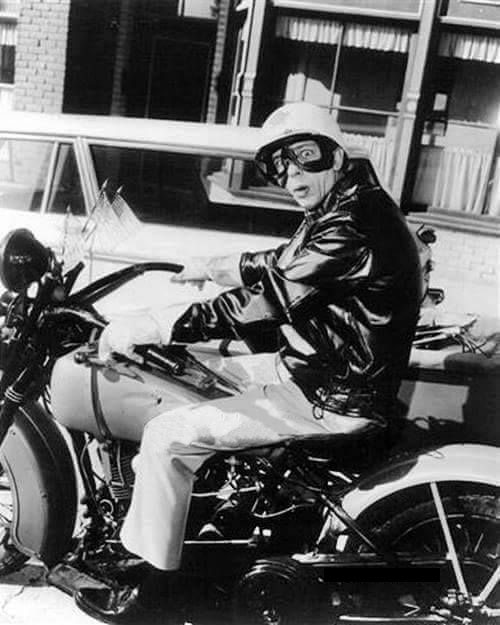
There are really only two towns on The Golden Isles Parkway between McRae and Brunswick and those are Baxley and Jesup. The rest are pretty much little wide spots in the road where the speed limit will suddenly drop from 65 to 35 and you have to be careful because Barney might be behind a bush on his motorcycle with the sidecar, wearing his helmet, goggles, gloves and scarf.

 Another of my favorites is Ga. Highway 42. Highway 42 begins in Byron and end at its northern terminus in Brookhaven, a suburb of Atlanta. It sort of has a special place in my heart for several reasons. First, it runs concurrently with U.S. 23 through East Atlanta, where I was born. This stretch of road is known as Moreland Avenue, which the road is known as from Conley Rd. to Ponce de Leon Ave, after which it becomes Briarcliff Rd. The portion of Highway 42 from the I-285 interchange to Ponce is part of the National Highway System, a system of routes determined to be the most important for the nation’s mobility, economy and defense.

The second reason Highway 42 is special to me is because when we moved from Gresham Park to Rex in 1973, our house was right off of the highway. I thought my parents had moved us to Hooterville, but that’s another story altogether. Not long after we moved there, I pulled up to the stop sign at Double Bridge Road and Hwy 42 and the street sign for the highway was laying on the ground next to the stop sign. I took it home and put it on the wall of my room. It eventually made it downstairs to my father’s workshop and disappeared when the house was sold in 2015.

Highways 162 and 36 are great stretches of road for driving and 42 from Forsyth to Musella is a beautiful stretch of road. As far as North Georgia, Highway 53 stretches in an arc from Watkinsville, just outside of Athens to the Georgia-Alabama state line, just north of Cedartown. Georgia State Route 60 runs off of 53 in Dahlonega and goes through Suches and Morganton to the Tennessee Line. It is a beautiful ride through the Blue Ridge Mountains, but in places it is definitely not for the faint of heart!

The longest Georgia State Route is Highway 11. It is 376 miles long and runs the length of the state from north to south. Its southern terminus is the Florida state line below Statenville and the northern terminus is at the North Carolina line north of Blairsville.

I don’t really use GPS when planning a route on a back road. For one thing, I don’t really trust it because not all of the back roads are in the system, at least not in the way it wants you to go. I prefer to do it the old fashioned way, looking at a map, plotting a course and writing the route down. I will admit I have grown to depend on the dash map on the system, comparing my notes with the system’s map. And while technology is wonderful and GPS was a scientific breakthrough, I kind of miss the old days when you would get the U.S. Atlas from State Farm in the mail each year, or pick them up at gas stations along the way. To me, something has been lost in not being able to read and follow a map.

Okay, I will admit that sometimes I get turned around and have to backtrack. But, I’m lucky enough to have a pretty good sense of direction, so I’ve never wound up in West Nowhere when I was headed to East Jesus. At least not yet.    

Learning To Drive | Three On The Tree

I learned to drive when I was thirteen years old. We had a dark green ’56 Volkswagen, the one that I would choose if I could have any car again that I ever owned.   I would sit in it for hours, pushing in the clutch, shifting the gears and pretending I was driving all over hell and half of Georgia, if not the world. On a Sunday afternoon in the spring of 1969, my father came to me and told me he was taking me driving. We rode through Gresham Park, down Clifton Springs Road and stopped just past the newly completed Panthersville Stadium. Beyond the stadium to the right was the construction site of DeKalb Community College South Campus. Daddy pulled off the road onto a flat dirt road on the construction site, which led all the way up to Panthersville Road. He stopped the little green Bug, put it in neutral, pulled up the brake, looked at me and said, “Alright, let’s swap places. I’m going to teach you how to drive.” We spent the rest of the afternoon riding up the road one direction, stopping, backing up and going back up the road the other direction. When it was time to head home, I stopped the car, put the shifter in neutral, pulled up the brake and opened the door to get out. “No,” said my father, “you’re driving home.” I was excited and nervous, but pulled out and headed back up Clifton Springs Road. Daddy sat in the passenger seat smoking a Lucky Strike and told me when to slow down, put on the turn signal and look both ways before pulling out. We made it home safely and I didn’t hit any mailboxes or run into a ditch. In retrospect, I’m really surprised how quickly I caught on. I had watched my parents drive for years, so between that and taking my imaginary trips in the Bug, I was familiar with the workings of a manual shift transmission.

It seems that a lot of us Boomers growing up learned to drive on a manual shift and usually a year or so before getting a learner’s license at age fifteen. My friend Dave’s family is from Adel, Georgia. He learned to drive at thirteen in his grandfather’s early Sixties Ford Ranchero with a three-on-the-tree. A three-on-the-tree was a three speed manual transmission with the shifter on the steering column. For decades it was standard equipment on most cars. If you wanted an automatic or stick shift, you had to order it. My parents’ ’65 Fairlane was a three-on-the-tree, as was my father’s ’60 Chevy Apache pickup.   Dave’s grandfather taught him on the back roads of Adel and whenever they would see a cop, Dave would sit up straight so he would look taller. He was tall to begin with, so he could pull it off. At thirteen, I could have been sitting on a large Atlanta phone book and still looked suspicious.

My father once told me that when he turned thirteen, my grandfather took him to the State Patrol headquarters to get a learner’s permit. “Does he know how to drive?” the patrolman asked my grandfather.
“Yes.”
“Well, let’s just go ahead and give him his license. Just keep an eye on him for a little while.” Things were a whole lot different in 1940 than they were when I got my learner’s in 1970.

Jackie learned to drive on her grandmother’s farm in rural Clayton County in her father’s 1955 Ford pickup truck. It had a 256 V-8 engine, a three-on-the-tree with a hydraulic clutch. If you learned to drive in something like that, you could drive anything. My friend Randy also learned to drive on a farm, his aunt and uncle’s in Newnan, Georgia. He and his cousin learned at age fourteen in, of all things, a 1957 Corvette. His uncle had it on the farm and it was, according to Randy, less than pristine. Ragged out, to be more specific. His uncle told them if they could get it running, they could drive it. What he didn’t tell them was they could only drive it on the farm. They got it running and spent the summer driving a Corvette convertible all over the pastures and dirt roads of the farm.

I tried to teach my daughter to drive in our ’69 VW Convertible. I was not successful. When she was little, I would take her down a small one-way street about a mile from our house, sit her up in my lap and let her steer while I worked the pedals and the stick. I remember my father doing the same thing with me, only he sat me up in his lap behind the wheel of our ’59 Ford and let me help him drive through East Atlanta. Things were different back then. When my daughter turned fifteen and got her learner’s permit, I was determined to teach her to drive a stick shift. I took her to the Ingle’s parking lot, taught her the basics and then we ventured out on the road. Try as she might, she never got the hang of it. I finally told her mother that it wasn’t going to work, so we bought her a used VW Rabbit convertible with an automatic transmission. She took to it like a duck to water and never looked back. She did eventually learn to drive a stick when she bought her first new car, a Honda Civic with a five-speed.

Learning to drive can be challenging, but it can also be funny. My friend Doug’s dad had a ’69 Camaro SS with a four-speed that he taught Doug and later his sister Deb to drive in. When it was Deb’s turn to learn, Doug wanted to come along for ‘moral support,’ so his dad reluctantly let him ride in the back seat. They lived on a gravel road and Deb drove down the hill to the dead end and had to turn around. About a dozen stalls later they were headed in the right direction. She stalled the car once again and Doug couldn’t hold it in any longer. He started laughing at her and she started crying. “That’s enough of that [stuff], said their Dad and made Doug get out of the car and walk home. Apparently Deb got the hang of it pretty quick though, because she threw gravel all over Doug as she drove up the hill.

Manual transmissions are becoming more and more a thing of the past, which is sad. To me there is nothing quite like taking a car through the gears on a curvy road. I think that is one of the things that made a Volkswagen so much fun to drive. Rowing the 60-horse engine through the gears took a good bit of skill and a lot of patience. About the only time a stick shift is no fun is when you are stuck in traffic, which is an everyday occurrence here in Atlanta.

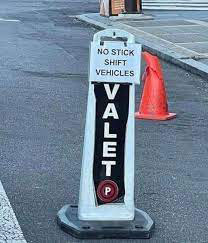
A generation has grown up not knowing how to drive a manual transmission. A couple of months back we ate at a restaurant in a Buckhead neighborhood with valet parking only. The sign pictured here was at the top of the lot. “So what if someone pulls in and has a stick shift?” I asked the young man standing next to the sign. He pointed at the street and said, “They have to find a place on the curb to park,” he said. I couldn’t believe it. I would have thought ‘Can you drive a stick’ would be one of the first questions asked in the job interview. Obviously not.

Things have changed a lot between 1970 and now, just as they had changed between 1940, when my father got his license, and 1970. Time marches on. I get that. But learning to drive was a rite of passage. I suppose it still is, to a certain degree. One thing about it, I guess these days it’s easier to teach your kid how to drive. No clutch, no stalling, no shifting gears while keeping your eyes on the road. Just think how much fun it’ll be to drive if eventually all cars go electric. I can hardly wait. 


In Fiberglass… A Vette

Corvettes have been in the news quite a bit lately, one Corvette in particular. I’m not going to get into any of that but I would like to talk about Corvettes in general. As a kid growing up you heard a lot about Corvettes and would occasionally see one on the street, but back then I was too young to know much about anything motorized other than my go-kart. I knew the guys on 77 Sunset Strip drove a Corvette, but about the only Stingrays I was familiar with were the two-wheel type from Schwinn and the real one that came across my Styrofoam surfboard and set my chest on fire in Fort Pierce, Florida.

The first Corvette I really saw was when I was twelve. It was also the first one I ever rode in. One of the older guys in the neighborhood, Dennis, bought one, a brand new blue 1968 model. He brought it by the house to show it to my parents and me. I stood and stared at the car, mesmerized. 1968 was the first year of the new Corvette C3 body style. It was like nothing I had ever seen in my young life. “You like this car, Jimmy?” Dennis asked. I told him yes. “Wanna go for a ride in it?” He didn’t have to ask twice. I think I was sitting in the passenger seat by the time he opened the driver’s side door. We went the long way around the block, up Rollingwood, down Flintwood, turned right onto Gresham Road, drove down and took a right Boulderview, then back down Rollingwood to our house. “How’d you like it?” Dennis asked when we pulled into the driveway. “It was great!” I gushed. “It was like riding in a spaceship!” He laughed, but in my twelve-year old mind, that’s what it was like. Low slung, shiny and sleek, sitting in the seat with the two front fender wells rising in front of me and the air dam on the hood, it was like riding in a rocket compared to my parents’ 1965 Ford Fairlane.

After that I was hooked. In my teenage years I inherited the ’65 Fairlane and later bought a ’69 Mustang Fastback. That was a cool car. I loved it, but in a moment of temporary insanity I sold it in 1974 for $1200 and bought a yellow ’73 Super Beetle. Now every time I watch Barrett-Jackson or Mecum and they roll out a ’69 Mustang I go out back, kick myself repeatedly and call myself all sorts of names unfit to post in a family blog. But, I suppose there are a lot of Boomers that have a similar story to tell.

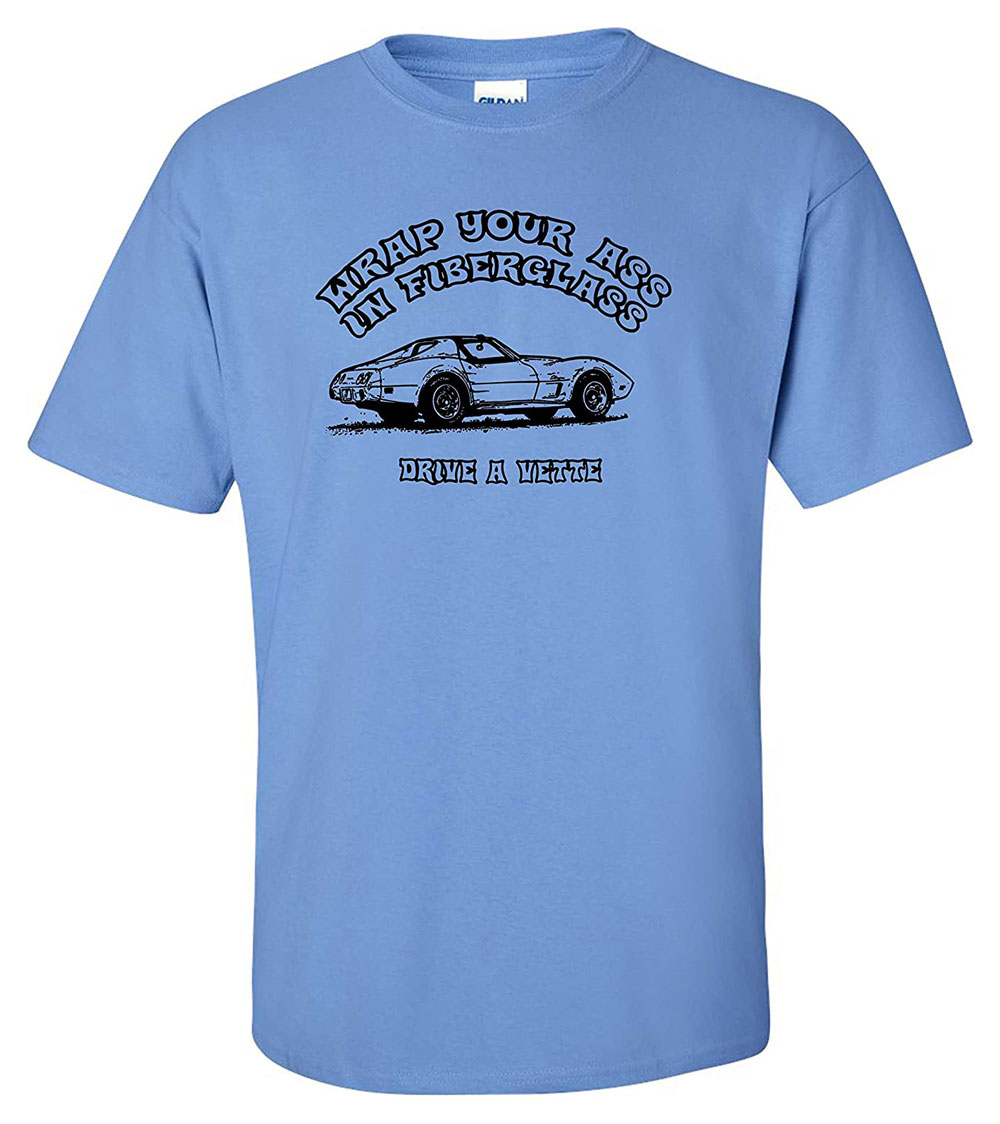
I drove the Super Beetle for fifteen years and it was a good car, but a Corvette was always on my mind, especially in the mid-Seventies. In 1976, during a trip to Daytona Beach, I bought a t-shirt like the one pictured here that said, “Wrap Your Ass In Fiberglass… Drive a Vette.” I brought it home and put it on a few days later before heading up to my friend’s house in Cedar Grove. My father went ballistic. “I can’t believe you wearin’ that blankity-blank t-shirt out in public,” he screamed, using words that were a whole lot more colorful than the one that was on the shirt. That was the last time I wore the shirt or even saw it because it disappeared after that. Then he proceeded to tell my uncles, cousins, his friends and anybody within earshot about “this blankety-blank t-shirt Jimmy bought in Florida that said, “Wrap yo’ ass in fiberglass,” sneering the words. He was fond of doing things like that. When I found the shirt online I thought about ordering another one, but decided against it. I guess by now the thrill is gone.

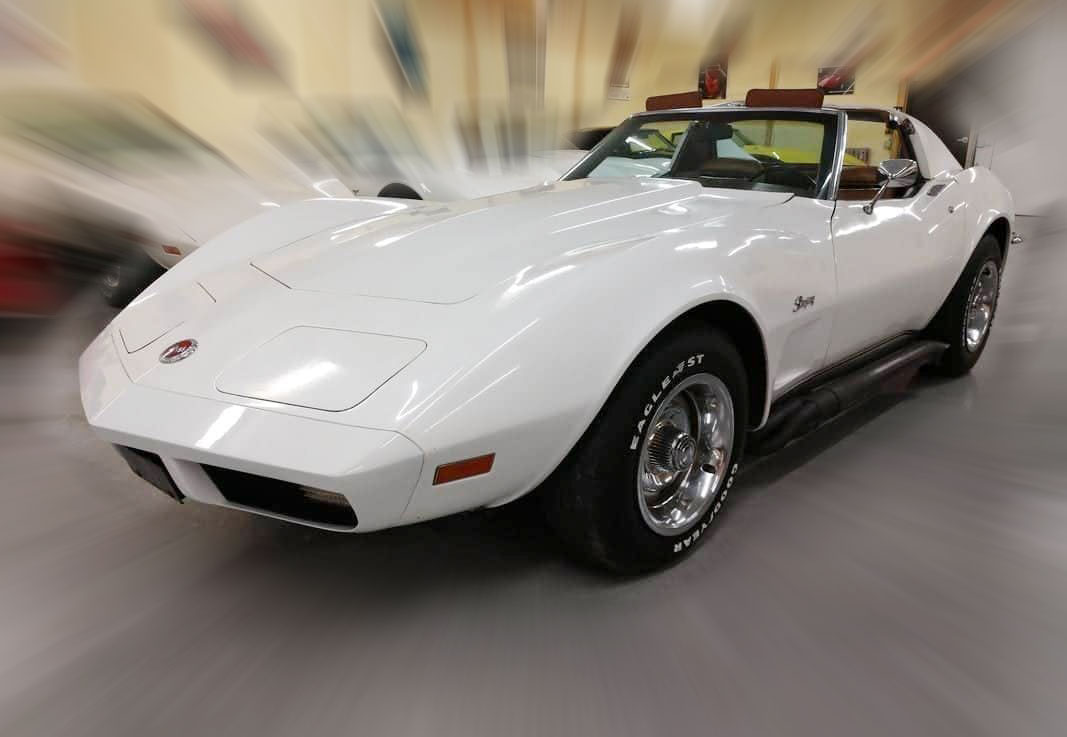
My favorite Corvette has always been the 1973 year model. That particular model was unique, not unlike the ’63 year model ten years earlier. The ’63 was the first year Chevrolet introduced the Stingray body style and the coupe featured a split rear window. The 1964 year model went to a solid glass window, making the ’63 an instant collectors’ item. The ‘73’s differences were subtler, but made it unique, all the same. A urethane bumper replaced the chrome front bumper and grille. The egg-crate fender vents were replaced with solid air-dam cutouts. The windshield wipers became hideaways that rested under the hood. The ’73 year model was the last year that the tail flipped up in a mini-spoiler shape. Interestingly, chrome bumpers remained on the rear but were replaced with urethane in 1974 and the tail sloped downwards. I coveted a ’73 so much I probably should have been on my mother’s Sunday school class’s prayer chain. I even had a favorite color scheme, white with a saddle-colored (tan) interior.

Unfortunately, it wasn’t meant to be. I saved up enough to put money down on a used white ’73 I found at Lamar Ferrell Chevrolet, but my parents refused to co-sign the loan. Then they told me our insurance agent said he couldn’t cover me on a Corvette. I called our agent and asked him why not and he told me that was the first he had heard about it. I had suspected a conspiracy but now had proof. I priced other insurance companies, but the dealership sold the car and that was the end of that. A few years later a buddy of mine bought a white ’73 with a saddle interior. He was good enough to let me drive it a few times, so I was able to live out my fantasies, somewhat.

The Corvette body style changed in ’82. I didn’t care much for the new body styles and pretty much lost interest in the Corvette, not that I could afford one anyway. By that time I had returned to my German automotive roots and was consumed with Porsches. I finally realized that dream in 1993 when I got an ’87 944 model. I drove it for six years until one night a deer jumped out of nowhere into my driver’s side front fender, turned and hit my back fender and was gone. It put a few dents on the fenders and knocked out the window. I drove the car to my friend Frank’s body shop the next day. He called me a few days later and said, “You’re not going to believe this, but their totaling this thing.” I was dumbfounded. “Why?” I asked. “Other than a few dents, there’s nothing wrong with the car.” “I know,” he said and went on to explain that the parts for the car were so expensive, it was more cost effective for the insurance company to total the car and part it out, or fix it and sell it wholesale. “You can pay to have it fixed yourself if you want,” he said, “but it’ll cost you more than the car’s worth.” So I took the check the insurance company gave me for the car and bought my daughter an ’87 white-on-white Volkswagen Cabriolet. Ironically, I drove that for a few years after she bought a Honda Civic.

For a car that was originally built to compete with the Ford Thunderbird, the Corvette bypassed that particular vehicle by leaps and bounds. The newest models are nothing short of wicked. If you can afford one, it’s pretty much like buying a European racecar right off the floor. From what I understand, the prices start around $60,000. I remember when the ’76 model hit ten grand. “That’s ridiculous,” I said then. “There’s no car worth that much, I don’t care what it is.” Now you can’t buy anything new anywhere close to $10,000, at least anything worth having.

And the Corvette isn’t built out of fiberglass anymore. It’s a mixture of composites and carbon fiber. My old t-shirt would be outdated by now anyway. The days of being able to “Wrap Your Ass In Fiberglass” are long gone. “Wrap Your Ass In Composite And Carbon Fiber” just doesn’t quite have the same ring to it. Maybe the t-shirt isn’t outdated at all, since you can still buy it online. The Vette on the shirt is a post-’73 Seventies model, too. Below is the link where you can buy the shirt, if you’re interested. If you purchase one, hopefully you’ll get to wear it more than once. https://www.amazon.com/Strange-Cargo-Fiber-Corvette-T-Shirt/dp/B00SG3LV4M

Drop The Top | Hit The Road

I love convertibles.  There is nothing like putting the top down and hitting the road, particularly on a beautiful fall day or a warm summer night.  Contrary to popular belief, summer days are not the ideal time to ride in a convertible, particularly during the dog days in Georgia.  Sitting down on black leather seats while wearing shorts is like sitting on a grill.  The problem with riding with the top down in the spring and autumn is that when dusk falls it gets cold in a hurry.  Jackie and I were at a fall reunion picnic at Vogel State Park in the North Georgia mountains a number of years back.  She wanted to put the top down on our Cabrio for the drive home.  I warned her, but she insisted.  About half an hour down the road the sun started to go down.  She had me pull over on the side of the road and we put the top back up.

I’d like to say I’ve always loved convertibles, but that’s really not the case.  The first convertible I ever rode in was a beat up old Oldsmobile 88 that belonged to the guy across the street’s father.  We would take it joy riding from time to time, always with the top down.  It wasn’t a joy ride unless the top was down.  I turned sixteen that summer and, for about fifteen minutes, drove a Myers Manx dune buggy.   It was technically a convertible, only I wasn’t allowed to put the top down.  Technically, it wasn’t my car.

Through the early part of the Seventies, the convertible was all but phased out in the United States.  Finally, in the spring of 1976, a Cadillac Eldorado billed as “The Last Convertible” rolled off the line. That was the end of convertible production by the American car manufacturers, until the mid-Eighties when Chrysler began selling the LeBaron with an after-market convertible top option.  Sales boomed and in 1985 Cadillac re-introduced the Eldorado Biarritz convertible.

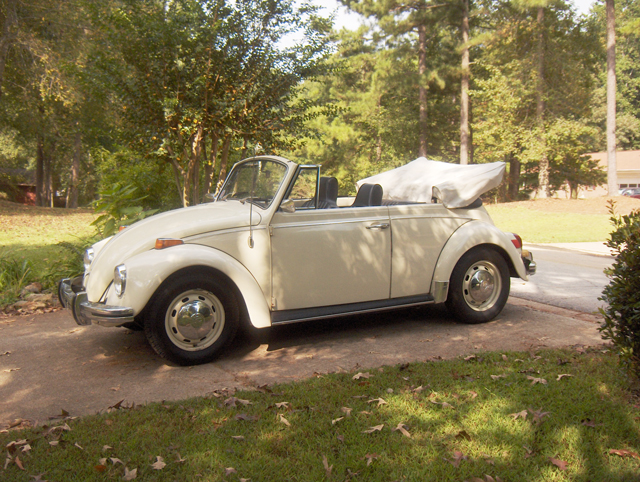
In the summer of ’76 I spent a week in Daytona Beach over the bi-centennial Fourth of July.  A friend of mine drove a big white 1973 Chevy Impala convertible.  He would put the top down and four or five of us would cruise up and down the beach enjoying the scenery.  After that I was hooked.  I promised myself I would have a convertible one day.  In July of 1983 that promise was fulfilled.  Being a Volkswagen guy, I bought a 1969 VW convertible from a buddy.  I paid him $500 dollars and a canoe for it.  The car was in pretty rough shape.  It had a couple of mis-matched fenders, as was common with VWs back then.  The back floorboard was rusted out and the top… well it didn’t have a top, only a frame and a boot cover.  None of that mattered.  It was a VW and it was a convertible.  We put the boot cover over the top frame, a piece of plywood over the rusted out back floorboard and hit the road.  I drove it back and forth to work all summer. 

There turned out to be a family connection with the car.  Jackie’s dad was a Bug man.  Like a lot of guys back in the Sixties and Seventies, he worked on VWs in his garage behind the house.  I thought my buddy told me he had bought the car from Jackie’s dad.  When I first met Jackie, I told her that I had a convertible that I thought may have belonged to them.  She told me no, they never had a convertible.  One thing the little car had going for it was that it had an engine that had been highly modified.  Her dad had hot-rodded the engine.  And he did a great job, too.  It was strong through the turns and on the straights.  You could drive it on the freeway and not get ran over.  Of course, that was back before there were knuckleheads in Chryslers and Mustangs driving on I-285 like they’re in ‘The Fast and the Furious.’   

That fall, I parked the car and began restoring it.  I had fooled with VWs my whole life, but had never done restoration work.  It was an eye-opening experience, to say the least.  It took a year and a lot of work.  The rusty floorboard was fixed with fiberglass.  The tires, seat covers and door panels were replaced.  The body was sanded and painted bright red.  Last but not least, a new black top was installed.  The trim was replaced on Thanksgiving morning and we drove the handsome little fellow to dinner at my parents house that afternoon.

Six years later the Bug went to the body shop for a proper restoration and a new pearl white paint job.  We were told that the pearl white would never be able to be matched should anything happen to the body.  It was painted a Volvo beige instead.  Five or six years later, while being serviced, a chain lift fell on the hood.  The hood was replaced and the car was sent back to the body shop, only to find out the Volvo beige had been discontinued.  The paint was matched as close as possible, but you can see a difference.  We should have stuck with the pearl white.

We bought my daughter a 1987 white VW Cabriolet with a white top and an automatic transmission for her sixteenth birthday.  Her mom drove a ’99 Cabrio.  For a time, we owned all three generations of VW convertibles.  I was a happy man and a proud papa.  My daughter eventually bought a Honda Civic and I inherited the white Cabriolet.  It was a great little car and drove it for about a year and a half.  But eventually it got to the point where I was putting about two quarts of transmission fluid in it a week.  We bought a Lincoln, I inherited the Cabrio and the little ’87 white Cabriolet was donated to a charity foundation.

By 2015, the electrical system on the Cabrio was pretty much shot.  We sold the car and I drove Jackie’s 2000 Beetle for the next five years.  The 2000 Beetle was the poster child for electrical problems for that decade and ours was no different.  The ’69 had been put into storage and we were both missing having a convertible.  So in January, we came full circle, trading the 2000 in for a blue 2014 2-liter turbo RLine Beetle convertible.  I always loved the Cabrio the best, but this little beast is in a category all its own.  Not too long after we bought the car, we were heading out I-20 to Madison for dinner with Jackie’s sister and brother-in-law.  Jackie was texting and not paying attention to what was going on.  I was cruising at eighty mph, passed a car and let The Beastman climb up to ninety.  Traffic was light, so I decided to let it continue to climb.  We were running ninety-five and crept on up to a hundred.  “Well, honey,” I said, “we’re sitting on triple figures.”  “What do you mean?” she asked.

“I mean we’re sitting on triple figures.”

“You mean we’re going a hundred miles an hour?”

“Yep.”

“Oh, that’s great, Jimmy, get us a ticket!”

She then leaned over and looked at the speedometer.  “Are we really going a hundred?” she asked.  “On the nose,” I replied.  Sitting back in her seat, she said, “Wow.  It doesn’t feel like we’re going a hundred.  It doesn’t even seem like we’re riding in a Bug.  Nothing’s shaking, rattling or sounding like it’s about to fall off.”  I laughed and eased the speed back down slowly.  Too bad we didn’t have the top down. 

Slot Cars | Woody, Skeeter and Huey

There were a lot of cool crazes in the Sixties. From surfing, both the aquatic and sidewalk varieties, to superballs, tie-dyes to troll dolls, mini-skirts to mood rings, go-go boots to granny glasses, the Twist to turtlenecks, the decade was defined by these fads and a host of others. In 1965, a craze hit the States and took off, bringing millions of boys, teenagers and dads along with it. I’m talking about slot cars.

Slot car tracks opened in just about every suburban neighborhood in the country. The tracks were big and made from wood. Most tracks consisted of eight lanes had featured hills, hairpin turns, high banked curves and long straightaways where you could really open up your miniature Maserati. You bought time on the lanes, generally in fifteen or thirty-minute increments. My father built and raced model airplanes, so naturally he and I jumped into the slot car scene with both feet, along with my cousin Herb and Uncle Tub. Herb and Uncle Tub lived in Forest Park, south of Atlanta. There was a slot car track called Buddy’s at the corner of Ash Street and Forest Parkway, which was then known as Central Avenue. There was one track in Buddy’s. The place was always jam-packed and smelled of cigarette smoke and oil of wintergreen, a tire additive. After a year or so, Buddy moved the raceway to a shopping center at the corner of Ash Street and Morrow Road. It was a bigger place and he added a second track.

In Gresham Park, Clifton Springs opened a track in a building that was originally a dance hall and then a bowling alley. If memory serves me correctly, Clifton had two tracks. It was great because it meant that racing could now be reached via bicycle.

One night a week, usually on Friday or Saturday, my father and I would ride down to Forest Park with a couple of cigar boxes containing cars and equipment, or Herb and Uncle Tub would ride up to Gresham Park. We would spend some time hot-rodding our cars by re-winding the engines, putting higher gears on them or custom racing tires. Herb had a blue MGA with a Tiger X motor in it. It was fast as lightning but had trouble holding the track. One night before we went to Buddy’s, Herb put two wide tires on the back. My father laughed and said that it looked like Fred Flintstone’s car. It may have looked funny, but the trick worked. After that, the little blue beast held the track like glue.

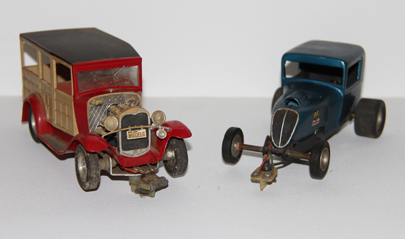
The cars I owned were a red Ferrari formula racer, a Mercedes gull-wing, a ’64 Mustang and a 1931 Ford woody surf wagon that my father built. It was a little top-heavy and very slow. It was fun to run around the track and always got a lot of comments, but it got pretty boring after a few laps because of the lack of speed.

The woody may have been a little top heavy, but it was nothing compared to Huey’s Hut Rod. Huey’s Hut Rod was one of the Weird-Oh models that were popular in the Sixties. Huey was a typical Weird-Oh character in a dragster built from an outhouse. I put the kit together and my father modified it onto a slot car chassis. Huey always got a lot of laughs at the track, but he was hard to control because he was so top-heavy. If he was on one of the outside lanes he would always topple over in the high banked curves, simply because he was too slow to stay upright. He was so tall that he would block two or three lanes until a track attendant could reach him and set him upright. This would cause problems, particularly if a couple of cars were seriously racing. People began to complain, so I quit taking him to the track and eventually gave him to one of the other kids in the neighborhood.

The first controller I owned was one that was pistol-shaped with a trigger for the throttle. The problem was that it got very hot after about ten minutes of racing. I saved up my grass-cutting money and bought the industry standard, a Cox controller, which used a plunger throttle and was designed to remain cool in your hand. I still have it stashed away in a box somewhere along with some other slot car gear that was in my father’s workshop.

One Saturday night, my father and uncle took Herb and me to the old Peach Bowl racetrack in Atlanta to watch a new class of racers called super modified, or “skeeters.” The cars were fast, loud and furious. An Atlanta racer whose name long escapes me won that night, driving a blue car that was the back end of a ’32 Ford sedan and the front end of a Fiat Topolino. The next week I went to the drug store, bought a model of a ’32 sedan and a Topolino, chopped them down, put them together, painted the car blue and mounted it on a slot car frame. Daddy rewound an engine, hooked up a top-end gear and we had ourselves a race car. And boy would it run! I won several heats with it both at Clifton Springs and Buddy’s. One night I won a feature race at Clifton Springs and the best part was my cousin Herb and I finished first and second, with me just nosing him at the checkered flag. I didn’t win a trophy, but to the best of my recollection I won an hour of track time and a ten dollar gift certificate. Herb won a half-hour of time and a five dollar certificate. In those days, five and ten bucks went a long way at the slot car track.

When I was sixteen or seventeen, a friend and I drove the big hobby shop in downtown Decatur and ran cars for a couple of hours. It was the last time I ever went racing. The craze had just about wound down and it wasn’t long afterward that the last of the tracks disappeared.

Only two of our cars survived and are pictured above, the woody and the skeeter. They sat my father’s big glass cabinet in his workshop until we sold the house in 2015 and are now in the display cabinet in our den with all of our memorabilia. I often wonder if they would still run. I wonder if there are any tracks around?

The Lion Cried

From where he lay, the lion saw them coming. They had scaled the brick wall surrounding the cemetery and moving toward him wearing black clothes, gloves and masks. Each of them was carrying a bag. He watched them carefully as they crept past the grave markers of the three thousand unknown souls he watched over that night, just as he had done each day and night for the past one hundred and twenty six years.

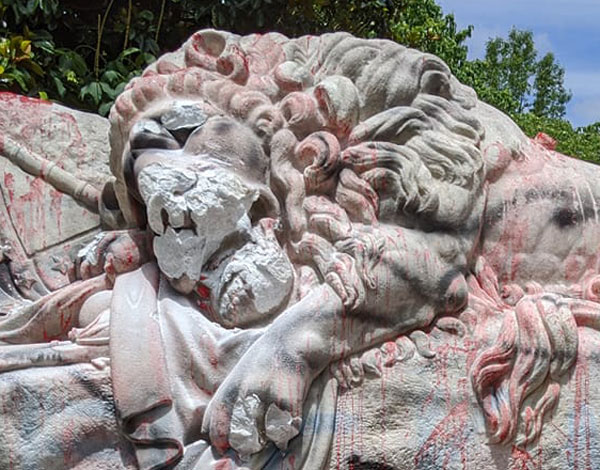
When they reached the iron fence that surrounded the lion, they climbed the fence and stood in front of him. One of them took a can out of his bag and then stepped up onto the pedestal upon which the lion rested. He then grabbed the lion’s ear and began to spray red paint from the can into the lion’s eyes. The paint burned and stung as they all began to laugh. The vandal continued to spray until the lion’s entire face was covered with red paint.

Several more climbed up and began to cover his body with red paint, from where the spear had been driven into his side and broken off, to his tail, to the flag which he clutched with his right paw and rested his head upon. The paint ran down the side of the lion’s body and onto the pedestal. They all climbed down and as the other vandals began painting over the inscription carved into the pedestal, the one that had spray painted his face reached into his bag, producing a hammer and a chisel.

He climbed back up onto the pedestal and chiseled out the lion’s eyes. He then knocked out his teeth and chiseled his nose from the bridge to the tip. He hacked off his whiskers, carved up his chin and finally broke two toes off of his front left paw. The lion howled in agony. The vandal then jumped down off of the pedestal and over the fence. They stood and laughed at the lion, hurling curses and insults at him. Then they turned and ran toward the three thousand unmarked graves.

The lion tried to let out a roar, but it would not come. The vandals began to overturn headstones and kick up grass and dirt. Then they began to deface the headstones with red and blue paint. Though the vandal had chiseled out his eyes, the lion was still able to see. He saw with his heart and the three thousand souls within him. It was then that the lion saw those souls, swirling through the limbs of the trees and in the air above the graves. Laughing, the vandals then ran for the brick wall surrounding the cemetery. They scaled it and disappeared into the darkness, not knowing that the souls of the graves they had desecrated were following close behind, as they would for eternity.

The remaining souls returned to their graves. Many of them were little more than children. They had fought in a war many of them did not truly understand. They died unknown and were buried in unmarked graves. Their families never knew what became of them, where or how they fell. They only knew that they never came home. The night was still, dark and quiet. Lying defaced and humiliated on his pedestal, the lion looked at the desecrated graves and for the first time in the one hundred and twenty six years he had watched over the three thousand unmarked souls, the lion cried.

The Hut Rod

The following is an excerpt from “Bikes, Boards and Coaster Wagons”, a chapter in “A Place And A Time.”

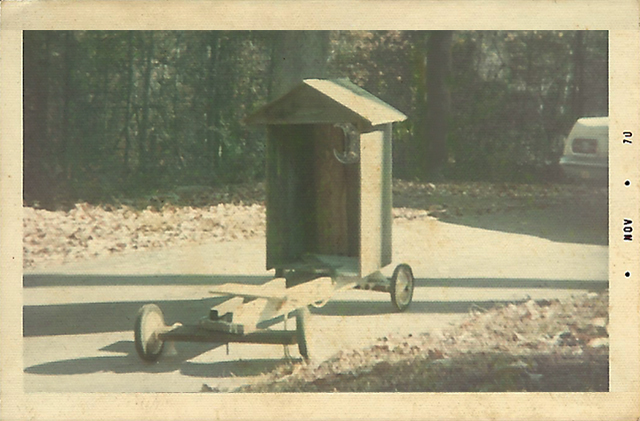
“After we outgrew the old coaster wagon it stayed propped up on one side in a corner of the garage.  My father suffered a heart attack when I was fifteen years old.  While he was recovering and not long before he went back to work he began to work on projects around the house.  One day when I got home from school he said, “Come on downstairs, I’ve got something to show you.”  We walked down into the basement and sitting there in the middle of the garage floor was the old coaster wagon.  It had been drastically modified.  He had put a wide seat of plywood on the bottom frame and built an outhouse around it, complete with a half-moon on either side so that you could see out.  It was open in the front with a footrest horizontally across the frame and it still had the original steering rope.  It looked just like Huey’s Hut Rod from the old Weird-Oh model kits we used to build not too many years before.  “I got bored,” he said, “and this is what happened.”  Even though we were fifteen and had outgrown such toys we rode the Hut Rod down the street all the time.  The only problem was that the Hut Rod was a little top-heavy.  Once while trying to show off I made a hard left turn at the bottom of the hill and turned over on the side.  I scrambled out and managed to get it upright before a bus came barreling down the hill. 

I took a picture of the Hut Rod parked out in the driveway.  It was taped to the door of the big cabinet in my father’s workshop for years.  I don’t know what became of the Hut Rod or the picture, but I have my suspicions.  I’m pretty sure that the Hut Rod became scrap wood when we moved from Gresham Park.  The picture was filed away elsewhere after my father had passed away.  Whatever happened, the picture is gone now as is the cabinet.”  

As it turned out, the picture was not gone after all.  I was going through one of the many photo albums my mother kept and ran across a number of pictures from the old neighborhood in Gresham Park.  And as I turned one of the pages, there was The Hut Rod.  I took the picture out and scanned it immediately.  Thanks to my mother and modern technology, the Hut Rod is saved not only as an Instamatic print developed at K-Mart in November of 1970 but as a digital file as well.  Below is a full-sized shot of the picture.

The memories are there.  They always will be.